Showing posts with label Austria. Show all posts

Friday, October 31, 2014

BIG Breath and....

It's been quite some time since I punched a few lines onto this blog.  August and September was all about training for a Century ride, leaving me with surprisingly very little say.  We had a rather pleasant 100 mile ride in mid-September and then after that a tight schedule leading up to our annual trip back to Akron.  Now, here we are at the very end of October.

The trip "home," the definition of which is up for debate, is an interesting experience for expats.  For those that can travel back and forth to their native land regularly the disconnect probably isn't as acute.  For those of us who only get back once a year or less, the experience can be, well, rather bizarre.  The more time that passes on assignment the greater the gulf can grow between then and now, here and there.  Sometimes, when faced with the reality that this is just an assignment and home will most definitely be over there again, the feelings are mixed.  Unless someone's expat journey has been completely negative, we feel a kinship with the new place sometimes equal to or even exceeding our native home.  But, for now here we are back in Germany for the time being with at least another year to enjoy it.

Besides all the fun parts about the home leave trip like sharing a drink at our favorite craft beer bars with good friends, enjoying a proper steak, and an early Thanksgiving meal with family, one of the annual events of home leave is making the rounds to all our medical professionals to make sure we're still doing good health wise.  I was looking forward to this year's checkup because I had a question.

My last post on here was about a particularly brutal climb that almost did me in.  After that I started paying close attention to my performance on hills and during other activities like mountain trekking.  It became clear to me that something was up with my breathing.  In the past I assumed my complete meltdowns on hills had to do with overall fitness.  I assumed I was struggling because I was out of shape.  But, as the year passed this excuse didn't seem pertinent.  We were cycling every day and during our century training we were averaging 130km a week.  Our diet has changed to being mostly vegetarian.  My weight and other vitals were in the right places.  I was sleeping normal.  But, every single time I hit a hill on the bike, a set of stairs, or an uphill track while trekking I started struggling, big time.  Off the bike I manage, but always slow way down and need breaks now and then to catch my breath.  On the bike, things get bad on those hills.  For anything above a Cat 4, I often have to dismount to calm my breathing.

Then, one day we were climbing a hill at a particularly slow pace.  We had taken a break not long before for a snack and to replenish our water, but I was in a bad way already.  My husband led for a bit, then I took over, hoping that if I found a steady pace I could relax my breathing.  It wasn't working.  The wide spot in the road was a welcome sight and I pulled over, dismounted, and sat down, certain I was going to black out.  When I finally got back to a comfortable heart rate and breathing, I looked up at the hill, the road winding above me.  As I did so, a woman went past.  On a steel city bike.  In khaki shorts and tennis shoes.  She was breathing through her nose.  That was the last straw.  I was mad.

Something was definitely up.

So, I sent my doctor in Akron a note.  I have an amazing doctor back in Akron, and having her just an email away is a lifesaver.  Thank you, modern technology!  Anyway, after tracking my symptoms and performance it sounded to me that I might have been suffering from exercise induced asthma all this time.  She concurred with my theory and set me up for some tests when I came back to town.

Asthma tests are something else.  You spend two hours in a room with a technician blowing into a tube after inhaling a progression of medications as the tech instructs "BIG breath and..BLOW, BLOW, BLOW!"  All of that tests lung capacity.  People with asthma will have a marked reduced capacity during the test.  People without it will have the same results from beginning to end.  When I sat down with my doctor a few days later, she said, "I'm so glad you contacted me, because you totally have asthma!"  Apparently, I have had it my whole life, explaining why I could never run the mile in PE or keep up in any sports like soccer when I was a kid, hence being assigned more stationary positions like fullback.  I was under the impression that I wasn't "good at running" or that I wasn't "athletic" back then.  But as I've gotten older I've realized that being "unathletic" isn't a real thing.  My doctor confirmed.  She said we choose to be active or not.  Sure, not everyone is built to run a marathon or bench 250lbs, but everyone should be able to find something they can do comfortably that keeps them physically fit.  If you struggle despite being fit, then there is a medical reason for it.  Anyone should be able to exercise.

I don't know what my doctor thought, when I responded to to my diagnosis with, "Oh, thank God!"  I can't begin to describe the relief I felt with finally having a reason for why climbing nearly kills me, why I can't keep up in the mountains, why climbing the stairs to the top floor our house has me leaning against the door frame for a bit.   The thought of climbing no longer fills me with dread.  I know what will happen when I start heading up and I know why.  It's not because I'm a failure.  I have the tools to deal with it and now the odds are in favor of me getting to the top without passing out.  Sometimes an answer is all you need.  And, albuterol.

The mountains are my favorite place on earth.  Now, spending time in their heights shouldn't be such a struggle.

Yeah, folks, I'll be "doping" when I'm out on the roads.   Let me get that out there right now.  Along with my patch kit and PB sammies, I'll be packing an inhaler.  I've accepted that in order to keep this managed properly I have to reign in my riding when I have a respiratory illness to avoid aggravating the disease (hence why I'm typing this up today instead of HTFU on the bike with this head cold).  I shouldn't take up extreme altitude mountaineering either.  Sigh.  Oh well, I don't have the money for that anyway.  But, there is no risk of having to give up the bike.  I'm not expecting to take all the local QOMs, but climbing the stairs, yeah, I can do that now.

So, look out, Bavaria, as soon as I kick this darn cold I'll be back.  Here's hoping none of you in khakis and sneakers will pass me on a climb.  But if you do, let's be clear.  My chain slipped.

Thursday, April 24, 2014

Hitting the Alpine Trails

So, hiking in Europe is a pretty big deal.  They don't do it like we do in the States.  Being out in the backcountry, carrying everything you need to live on your back, filtering your water, and obsessing about bears is an incredible experience that I can't recommend enough- seriously.  But in Europe, long distance backpacking is more a leisure activity, not an exercise in survival.  You don't carry dehydrated food, you don't even need a tent.  In the very popular spots, there's food and drink along the way and there's a bed of sorts available at the end of the day.  Of course, that all comes from the fact that Europe has a lot more people in it.  You're never far from civilization.  And that can make the walking all day thing a whole lot of fun.  Did I mention there was beer?  If you love backpacking in the States you'll love it just as much in Europe.  Maybe more.

The Alps, be it the French, Swiss, Italian, Slovenian, Austrian, or German (not to mention the Liechtensteiner and Monacan), is one of the most popular places to go for a hike, wander, or trek.  Let me tell you, you've never hiked in a place quite like this.  Over the holiday weekend we drove down to the Austrian Alps to get some quality mountain time.  Usually, April is the off season in the mountains, bridging the gap between ski season and the warm weather that permits high altitude trekking and climbing.  Thanks to the unseasonably warm weather this Spring the higher trails were mostly accessible despite one overnight light dusting.


The great thing about hiking in Alpine countries is that people have been doing that sort of thing there for quite some time.  The trails are well established and well marked.  The maps (available at every little tourist information office in every little town) are proper maps.  They're waterproof, have scales and keys, and they have topo lines. They're basically USGS grade and this makes me very happy.  You'd be surprised how rare it is to find tourist maps at this level of detail, and a good map can make or break a hike.  Well, all the maps produced by the tourist bureaus in the Alps are good.  Between the signs at every trail intersection (they're even in the really barren, hard to get to places) and these perfect maps, you don't have to worry about losing your way.  You can plan a route down to the minute.  Plus, along the way there are huts (also labeled on the map).  These huts aren't just lean-tos with a picnic bench.  A lot of them are staffed, rent beds, and serve meals.  One that we came across brewed beer, pretty good beer actually.  There are trails everywhere.  All are labeled on the maps and points of interest are indicated on the trail with walking time.  They even color code the trails for difficulty level.


Despite the cushy support system, the trails can still kick your butt.  Sure, some of the hut to hut circuits stay more or less on the flats and are family friendly.  But, head up a little higher and bring your trekking poles and a good set of boots because you'll be scrambling, balancing on cliff edges, and possibly tackling some snow.  Head a little higher and there are via ferrata routes or bring your ropes and pitons.  Anyway you want to do it, you'll have fun.  Beer, alpine cheese, and hot coffee aren't that far off.  Of course, it's the scenery that makes a good hike, and the Alps have good scenery in spades.


So, if you're visiting Europe take some time away from the cities and sightseeing, grab a daypack, strap on your boots, and go for a walk in the Alps.  You won't be disappointed.

Wednesday, May 15, 2013

The Place

Forty-five miles southeast of Salzburg lies a cool black lake, the surface of which barely shows a ripple.  Above the lake tower the mountains of the limestone alps, snow still resting on the heads and shoulders of the loftier peaks.  Waterfalls cascade down to the lake from unseen heights above.  Perched precariously on the slopes of one of the mountains is a village.  This village is the place.


People first began to settle this secluded spot in what is now Austria at least 7,500 years ago.  Why?  For the same reason people settle anywhere, they found a resource.  In this particular case, the resource was one of humanity's most important minerals, salt.

wikipedia.org
Salt is a necessary element to the survival of every living thing as it is responsible for water regulation in the body.  If you have too little salt in your system, you can become quite sick, even die.  Too much, and you have similar problems.  Of course, salt is important to humans for other reasons.  We put it on our food to add flavor.  Until canning and refrigeration were developed, salt was used to preserve food, especially meats, for long term storage.  So, when humans first arrived here and noticed salt brine pouring out of mountain springs, they knew they were onto something.  Initially, the salt brine was collected in earthen jars and the liquid was evaporated off, leaving the salt crystals behind.  Sometime during the Late Bronze Age, the first systematic mining began using simple tools like deer antlers.  Later, during the Iron Age, salt production had become so successful it led to the cultivation of a highly sophisticated settlement.  Hallstatt means "salt settlement," from the Celtic word Hall- meaning salt.  The village's archaeological site from the Iron Age became the type site of what is now known as Hallstatt Culture.  Hallstatt Culture is the first definitive period of the broader Celtic culture, the largest prehistoric and protohistoric people group in  Europe until its Roman takeover in the first century BC.  Salt production in Hallstatt has been carried out nearly continuously until present day.  The salt mine above the village is the oldest in the world.

View over Hallstatt from the salt mine.

Today people come to Hallstatt for a number of reasons.  Tourism, not salt, is the village's main source of income.  As the local population numbers decline, the villagers rent out rooms to tourists in their massive 18th Century alpine family dwellings.  The salt mine, while still in operation, is now also open to the public where they can learn about the prehistoric miners, geology.  You can ride mine carts and slides all while wearing the provided coveralls.  Another attraction is the Hallstatt Museum which relates the history and archaeology of Hallstatt in modern exhibitions.  Probably the most interesting sight in town is the ossuary behind the Catholic church.  Until rather recently, graves in the tiny Catholic cemetery were disinterred to make room for new tenants every 10 years.  The bones of the former occupants were cleaned, the skulls painted with their names and dates along with some flowers, and then stacked in the ossuary for display.

Besides these unique sights, the real attraction is the town itself.  It is the quintessential Alpine village.  Hallstatt will provide you perfect postcard photos no matter the direction or season.  The restaurants serve fresh fish from the lake and rivers.  As mentioned before, the accommodations are the guest rooms in the beautiful houses of the village.  The shopping is quite unique for a tourist town.  Nearly every shop sells distinctive locally made goods from ceramics, to jewelry, to soaps, to woodcrafts.  You can even buy lamps made of salt from the mine.  There are also places in town to pick up outdoor gear, for those visiting the region for its recreational offerings.


Mountain biking, backpacking, day hiking, rock climbing, and scuba diving are all popular sports in the area.  Gondolas can take visitors up to the higher peaks or people can choose one of the many alpine trails to reach these stunning places on foot.  The tight roads along with the high traffic of buses and out of town drivers doesn't lend the area well for road cycling, at least in my opinion.  But, to be quite honest, this isn't an area you want to speed through.  You will want to savor this place.

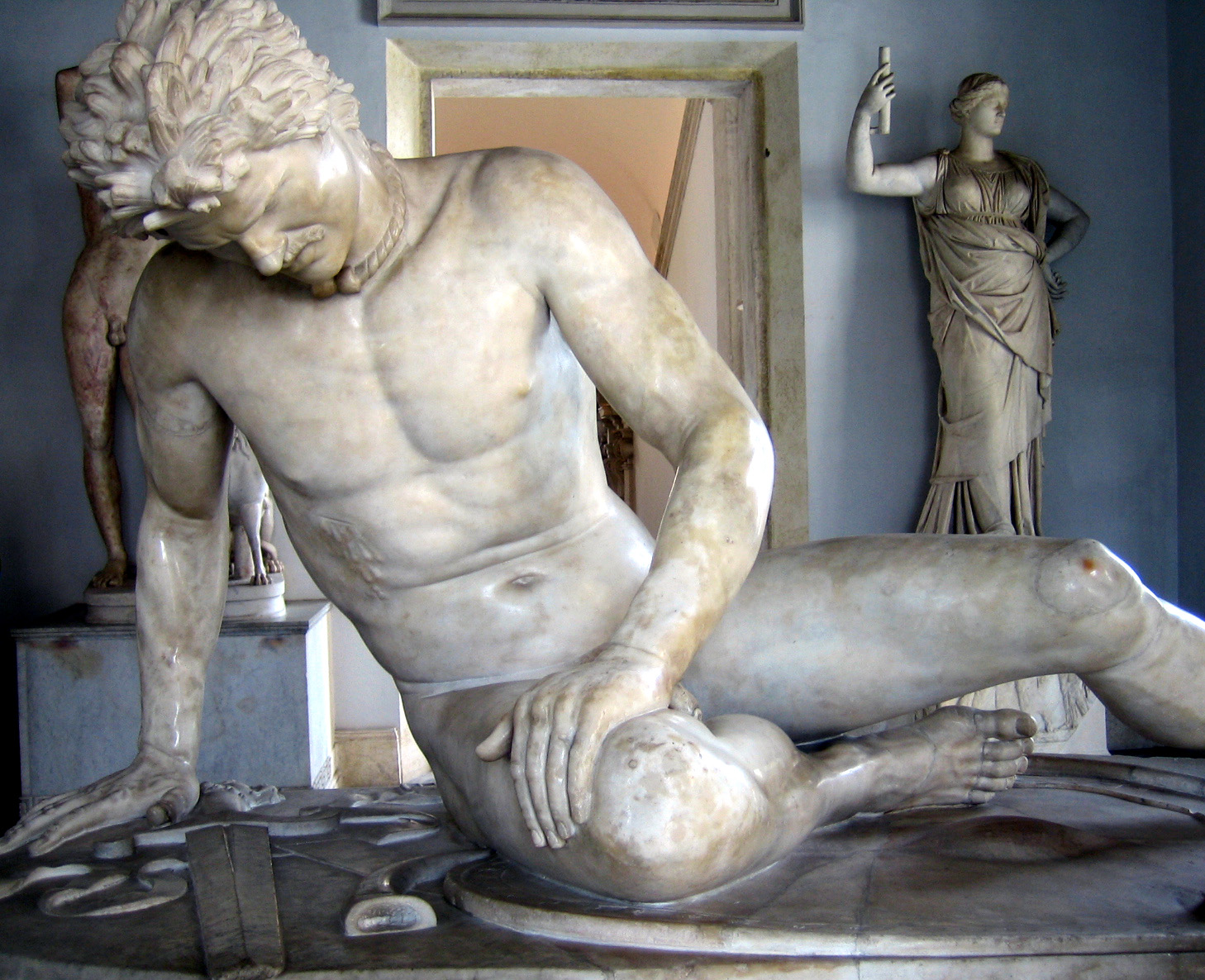
The Roman copy of the Hellenic original, The Dying Gaul.
We went to Hallstatt for the archaeology.  As a young student, it was the Celts, not the Romans, Greeks, or Egyptians that captured my interest.  Today, the terms Celt and Celtic generally refers to the non-English inhabitants and culture of the British Isles and most specifically the Irish.  However, from approximately 800 BC until 1 BC, the Celts were the dominant people of continental Europe.  Their towns, scared places, and trade networks were well established when the Romans were still herding goats on Palatine hill.  They were farmers, merchants, artisans, doctors, poets, astronomers, craftsmen, and warriors.  They were just as influential on European history as their rival Romans.  Their territory stretched from Ireland to Romania, and as far south as the Portuguese coast.  Celtic colonies have been found in the Ukraine and Turkey.  The famous Gauls of France were in fact Celts.  They sacked Rome in 390 BC and clashed with Julius Caesar during the Gallic Wars over 300 years later.  Celts founded the city of Milan in northern Italy and it was to Celts that Paul evangelized to in Galatia 50 years after the death of Christ.  Celtic influence can be seen all over the continent today, over 2,000 years after their final defeat at the battle of Alesia.  The country code for Switzerland, CH, comes from the country's romantic name- Confoederatio Helvetica.  The Helvetii were the Celts of Switzerland during Rome's expansion into the continent.  Belgium gets its name from the Belgae tribe.  While France gets its name from the Franks, a Germanic tribe, genetically a majority of the French population is Celtic and their language is a blend of Celtic languages and Latin, hence why it looks like a Latin language, but doesn't quite sound like one.  The regional languages spoken in Brittany, Breton and Gallo, are Celtic languages.  The populations of Austria, Switzerland, and Belgium are also still quite Celtic in ancestry, despite millennia of migration and conflict.  Today, the last recognizable Celtic "nations" are Ireland, Scotland, Brittany, Cornwall, Wales, and the Isle of Man.  Alas, I digress.  The point is, the Celts of the continent were a vibrant people who tend to get skipped over in the history books.  That's what happens when you don't write things down.  Although they, like the Romans, had rich histories and mythologies, this knowledge was passed down generation to generation through stories and song.  They never recorded them with the written word.  Documentation was left to their Roman conquerors who, understandably, weren't exactly objective.

Monument to the archaeology of Johann Georg Ramsauer in Hallstatt.
mshanks.com
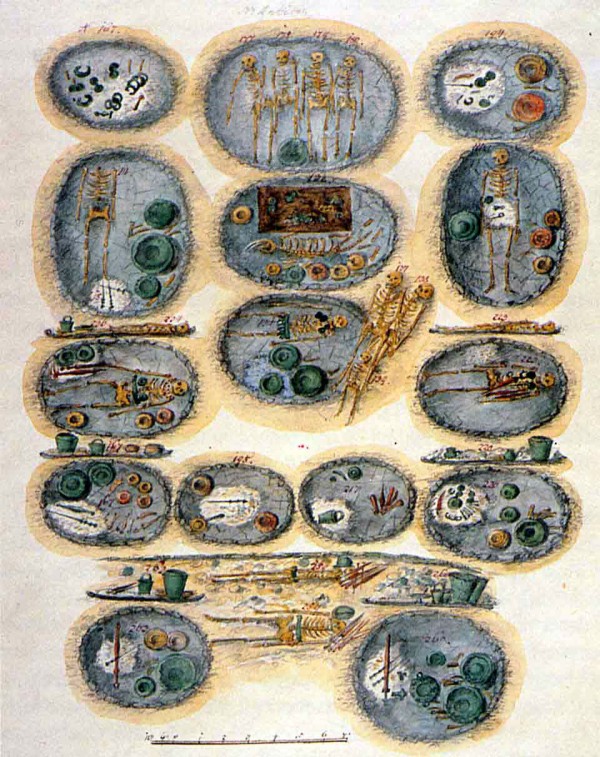
That's where archaeology and the village of Hallstatt come in.  In 1846, the salt mine foreman, Johann Georg Ramsauer, discovered an ancient grave on the hillside near the mine entrance.  He and his team subsequently excavated over 1,000 burials on the hillside.  His excavation techniques were remarkable by modern field standards.  He removed the soil layer by layer, took copious detailed notes, and created beautiful watercolors of each grave.  Hallstatt has one of the largest and richest cultural deposits from this period of prehistory and the site fleshed out our understanding of the culture that thus far had only been identified in Roman texts as a barbarian horde.  The grave goods of Hallstatt showed the Celts to be far from brutish barbarians.  Not only were the finds themselves extremely important for the narrative of Iron Age Europe, but Ramsauer's techniques helped to modernize the field of archaeology.  For those of us that have spent time studying this period, Hallstatt is a well-known name.  Since I first read about the place almost 20 years ago, it stuck in my mind.  There are very few places on earth that are not only that culturally significant, but also so stunning to look upon.

It meant a great deal to me to visit Hallstatt, mostly because of its significance in inspiring my eventual studies in history and archaeology.  There was something about that secluded place on the lake with its clues to history in the hillside and forgotten salt mine chambers that captured my imagination and eventually had me take up a trowel.  In the back of my mind, I had hoped to visit this site who's personal importance outweighed the Forum, Pompeii, the Pyramids of Giza, or the Serpent Mound.  It turned out to be even more enjoyable than I had imagined.  Besides the archaeology, all the other wonderful aspects of Hallstatt make a visit worthwhile.  I imagine that's why it is such a popular destination for people from all over the world.  In fact, it is so popular with the Chinese that there is an exact replica of the village in Huìzhōu.  Despite its popularity for tourists, Hallstatt and the region still manages to keep ahold of itself.  When the buses leave for the day, it is just a regular Austrian village.  The locals chat on the streets, boats head to and from their garages to fish the Hallstätter See, on Sundays the townsfolk can be seen wearing their dirndls and trachts.  While they no doubt tire a bit from the constant parade of foreign tourists through their town, you'd never know it.  No matter if you're stepping into a shop, restaurant or the museum you will always be met with a cheery smile.


While I'm sure to keep on traveling, I have a strong suspicion that Hallstatt, Austria has become and will remain The Place.  There have only been a couple spots to make the "must return to" list, most of them have tall mountains and clear water.  However, this place has that extra special something, something that has me saying we need to go back.  Again and again.