Showing posts with label history. Show all posts

Tuesday, March 11, 2014

The Most Important Patch of Land in France

There's an area up in northern France, you may have heard of it.  To look at it, you may not guess that it is probably one of the most significant places in the world.  Well, it is.

Utah Beach
Today, Normandy is one giant tourist attraction.  You'll hear more English being spoken here than you will French, even in the off season.  But, just a short 70 or so years ago this area was at the very eye of the storm during World War II.  One June 6, 1944, the Allies brought the fight to Hitler when they invaded Utah, Omaha, Juno, Sword, and Gold beaches.  From that point on, the tide of the war in Europe had definitely changed.

William the Conqueror's Castle, the imposing fortress of Falaise where the Duke
and future King of England was born and spent his early years.
But, incidentally, the events of D-Day aren't the only reason why Normandy is significant.  An invasion, this time in the reverse, which took place about 880 years prior is another claim to fame for the former Duchy.  Pretty much every student of Western history knows the date of 1066, when William the Bastard, Duke of Normandy, launched about 700 ships from Normandy on his way to the history changing battle at Hastings with Harold Godwinson.  The defeat of the Anglo-Saxon army by the Normans drastically altered the course of world history.  The repercussions of the Norman invasion cannot be overstated.  Normandy was William's home and where he spent most of his life, even after he became King of England.  It's where he learned to be one of the most successful military and government leaders to have ever lived.

Bayeux Cathedral, the original 
So, you see, Normandy is saturated in history.  It is positively dripping in it, actually.  The major cities of Caen and Bayeux are chock full of 12th Century edifices.  You can't turn a corner without running into some giant yellow sandstone monument to the Normans' power.  If you have a thing for medieval architecture, something I myself suffer from, you will be in heaven.  Despite the destruction of war that nearly leveled these cities, very few of the old buildings show any signs of that abuse today.  Bayeux is home to one of the most important works of European art too.  The Bayeux Tapestry resides in its very own museum in the heart of the city.  The tapestry is not only a work of art, but a historical document.  At seventy meters long, it tells the story of the Norman invasion, from Edward the Confessor's bequeathing of the crown to his cousin William, to Harold's adventures in Normandy, to his snatching of the crown upon Edward's death, to the building of the Norman fleet, to the final moments of the battle in 1066.  For a piece of cloth that is almost 1000 years old, it doesn't show it's age.  It's incredible, not only because of the level of craftsmanship and the aesthetics, but because of its fantastic detail.  You can learn a lot about what things were like in the Middle Ages just by studying this 70m long cloth.

Obviously, however, most people visit Normandy because of the events of 1944.  Today, it's hard to imagine as you walk through the quaint streets of the cities or the beaches the amount of violence that erupted here.  It's an inherently peaceful place of stone villages, seaside cottages, and sun dappled gardens.  But, you don't have to look too closely to see evidence of what went down here.


German jackboot print in a ruined artillery bunker.

One of Hitler's last surviving guns, now silent overlooking the Channel at Longues-sur-Mer
The D-Day sites of Normandy have been written about time and again by authors far more knowledgable and talented than myself.  I will not begin to pour into the events, the characters, and the immensities of D-Day.  It's too much to take in, process, and then re-disseminate.  I didn't expect to be moved when we visited the American cemetery.  I've spent many hours in cemeteries for my work back in the day.  Never once was I overwhelmed by a cross or a name and a date.  Here, however, I was.  How do you reacted to field after field of pure white stone representing a lives cut down in their prime for a cause they couldn't have understood?  I don't know.  It's something that has be seen to understand


So, visit Normandy? Yes.  Visit Normandy even if you don't care one iota about history?  Yes.  The food is good, and you may actually learn something too.  Learning never hurt anyone.  Normandy has a lot to teach.  It played a major role in two of the most significant events in world history, events which shape our present world.  Of any place in France, perhaps even more than that famous tower, this is one spot you should visit.

Tuesday, February 4, 2014

Crossing Paths

The road wasn't really a road.  It was the type of two track we used to enjoy plowing up in our Wrangler back in the day.  By the looks of things, nothing of that size had come through this way in quite some time, just people, dogs, and the occasional mountain bike.  We were on foot.  We had to be on foot this time.  I didn't want to miss a single tree, leaf, rock, or mud puddle.  We were following someone, someone I never knew or met.  He had been long gone by the time I showed up on earth, but he is a part of who I am nevertheless.  Life has a funny way of working out.  Of all the places to find him, I never thought it would be here, walking through the mud up a hill that doesn't have a name to a village that could barely be labeled as such to see a view that really isn't that incredible compared to others we've seen.  Then again, it was the most incredible of all.


It was a couple of days into the last real battle his Infantry division would see during The War.  They had just crossed over the Main River that day and were techincally behind the Nazi lines.  The Nazis weren't there, however, they had all been called into the city of Aschaffenburg, about 15km down river.  It was the end of March 1945 and the war in Europe would be over in little more than a month.  Of course, he didn't know that, even though up until this point they had met with little resistance from the Nazi forces.  But, for some inexplicable reason they were holding Aschaffenburg with surprising resilience.  His Field Artillery Battalion traveled in support of an infantry regiment assigned to attacking the city from the south.  So, here they were up on the top of an insignificant hill preparing to fire the big guns at one of the final military strongholds of the Nazis.

He'd landed in North Africa in June 1943, in July he was in the invasion of Sicily, and in September he and his division invaded Salerno.  In January of 1944, his division was ordered to invade behind the Gustav Line at Anzio.  They'd been dug in during that terrible siege for four months.  Next, in August, they landed in Southern France to begin the advance towards Germany.  They crossed the Belfort Gap, the Moselle River, the Mortagne River, and the Zintzel River, before they finally broke through the Siegfried Line on March 17, 1945.  By now, most of his friends that had landed with him in Africa had been killed.  But, after meeting little resistance since France, the men of his division began to think that they may make it home.  He had begun to make plans about life after the War.  He and his best friend Eddie had served together in the same Battery since basic training.  They talked about opening a car dealership back in New Jersey.  He'd written his fiancée about setting up the guest room for Eddie so he'd have a place to crash in a city that would be flooded with returning troops.  All they had to do was stay alive and wait for the fall of Berlin, which as this rate wouldn't be too far off.  Perhaps, if they were lucky, they'd get out of being sent to the Pacific.  But, plans change and war is unpredictable.

They crossed the Rhine on March 26th.  It was during that historic crossing that Eddie had been shot and killed right next to him.  It was a cruel twist of fate.  So cruel, he could barely bring himself to write home about it.  All he could say was to forget setting up the guest room.  Eddie wasn't coming home.  Now, here he was on this stupid hill a few days later preparing to bombard a city that for some reason just refused to accept the obvious and surrender.  Many of the men hadn't felt this low since Anzio.  More than likely, this was the worst he'd ever felt.  They'd hit that city with artillery for several more days to come.  The southern assault worked and the line was broken, but still the soldiers holding Ascaffenburg refused to give in.  By the end of the battle the American infantrymen were fighting hand to hand, from house to house with not only soldiers but civilians who answered the edict from Berlin to fight for the Fatherland to the death.  The battle lasted ten days.  When the city was surrendered on April 3rd, it was barely anything more than a rubble heap.  By then he was just outside of the city itself and the big guns were finally silent.  The massive Schloss Johannisberg was in ruins.  To the him and his fellow soldiers, it couldn't have seemed like anything more than a waste.  Too many people had died for nothing more than the twisted ideology of psychotic tyrants.

They didn't stay in these parts long.  They moved on to Nuremburg next and on April 29 members of his division liberated the Dachau Concentration Camp.  Two days later they captured Münich.  They'd be there on V-E Day and mercifully were spared that inevitable removal to the Pacific when Japan surrendered in August.  He'd get to go home after all.  He married his fiancée shortly after he returned.  They had two children.  He went to college and would go on to open that car dealership.  But, he never really came back from Europe.  The man who left for the War in 1943 was not the man who came back to New Jersey in '45.  He would still talk to anyone he met on the street, he was still unfailingly kind, he still had a sense of humor.  But, he had demons too, demons he picked up in Sicily, Salerno, Anzio, France, and a particularly nasty one that showed up while crossing the Rhine.  They kept him distant from his loved ones, they kept him from talking about the war, they drove him to the bottle and alcoholism.  It was thanks to those demons that he died long before he should have, long before I showed up to know him and have him tell me about this hill himself.

Nearly 69 years later, I stood on that hill too.  I learned about it not from family stories or old letters.  I learned about this hill from a US Army map stuck in a report about the Battle of Ascaffenburg.  I'd been reading the report to learn about where I live, not to find my grandfather.  As fate would have it, this hill is three miles down river from where I live, overlooking a town I ride my bike through regularly and across the river from where we get our groceries.  I'd been crossing paths with my grandfather almost every day, and I'd had no idea until I saw that map.  So, in some way I thought standing on this hill and looking out over a view he'd seen too would give me a glimpse into his life.  The only smoke I saw was from chimneys.  The only sounds came from children laughing in the village below and birds in the trees above me.  The view was of a quiet countryside.  It was the same hill, but it was not the same place.  Fifteen kilometers downriver, Aschaffenburg is a bustling city.  The castle is rebuilt.  The Germany I see, the Germany I live in, is a far cry from the one my grandfather saw.

So, I lit a candle.  I lit it not only for my grandfather who I've only known in photographs, but for all the men who's pictures hang on walls or who's names are inscribed on memorials.  I lit it to thank him and them for being willing to face the bullets and the bombs and the demons to stop a terrible evil so that the view I see can be only described in one word:  peaceful.

Sixty-nine years is a long time, and then again it isn't.  It's all too easy to acknowledge the past in passing, glance at memorials, pause at fluttering flags.  But slabs of marble don't always tell the stories that need telling.  Sometimes the landscape is the better bard.  I didn't see my grandfather's ghost up there, but I felt him just for a second or maybe I heard his voice in the sounds of birds and children.  "We fought here so you could walk here.  Don't forget us."

No, Grandfather, I won't.  Until I see you on the other side, I'll meet you at all the perfect and peaceful views you've given me.

Friday, August 2, 2013

Dungeons, Dragons, & Handmade Soaps

Summer time in this part of the world means it's also Medieval Fest season.  They range from small affairs to enormous festivals that draw people from all over the region.  These are popular events to bring children to so they can see jousting, hear some music, and watch all sorts of demonstrations from blacksmiths to falconry.  The adults like them because they're usually cheap, have plenty of food and drink, and they sport the best people watching this side of the Rhine.


Besides all the obvious reasons to check out a medieval faire, there is one other reason I try to get to at least one a year.  Believe it or not, these festivals are a great place to pick up some fantastic handmade goods.  Carpenters, potters, cobblers, soap makers, basket weavers, bookbinders, leather craftsmen, blacksmiths, and purveyors of home raised & crafted foods all have their wares for sale at medieval fairs.  Basically, these events are kinda like farmer's markets, except with choreographed violence and elaborate costumes.


At a recent fair, I picked up this leather book cover which the
book binder custom made while I waited.  The leather is local
and tanned with historic processes.  He also had bound books
with handmade paper and parchment.
Many of the vendors travel from fair to fair so they are used to speaking with tourists from all over.  Most of them are happy to discuss how they produce their goods and some (depending on what it is) can make custom products while you wait.  The prices are usually quite reasonable, and are a higher quality than anything you would find at a souvenir boutique.  Many of these items are also made in the historical traditions of the period and the vendors are quite proud that their products are authentic.

So, if you're looking for something different to do or are in the market for a unique gift or story, seek out one these medieval fairs.  There are even a few with a Roman theme, if you prefer gladiators and pickled olives with wine instead of knights and camembert sausage with ale.  One thing is for sure; you will definitely get a show.


Monday, June 10, 2013

Do Not Let These Roads Deceive You

We all have those rides that are just perfect.  From the moment we clip in to the final dismount, every moment is a joy.  Perfect rides are uncommon things.  We treasure every single one.

Just one of the views from the roads of the Belgian Ardennes.
It was no surprise to us that one of these rides would happen in Belgium.  I'm not going to tell you the specific route, except that it was around Bastogne.  The roads were devoid of all types of traffic and, well, I'd like to keep it that way.  There's something sweet about clicking into the big ring, getting down in the drops and just going, going for kilometer after kilometer without a care in the world.  We had that for 50kms.  When we weren't in the big ring, we were climbing.  Those climbs were steep and choppy, but clear to attack from whatever angle and pace that worked.  The only other traffic we encountered besides fellow cyclists was a tractor at the bottom of a descent and a tethered horse chilling on the MPU at the end of the ride.  They weren't your common obstacles, but at least they were few.  While it had been threatening rain and thunderstorms, we had hours of sunny bliss.  The storm finally arrived after we returned to our house in Ettelbruck, cleaned up, and had cold Belgian beers in hand.  We couldn't have asked for a better day.

The Bastogne region is a special place.  Cycling fans know it because it is host to La Doyenne, the old Liège-Bastogne-Liège race.  Those who are familiar with a little WWII history know it for being the center of the action during the Battle of the Bulge.  Nearly seventy years later, The War is still a raw memory in these parts.  Even where we live, further to the southeast, the memorials to resistance fighters and liberators dot the landscape.  The church in our town still bears the scars of mortars and bullets.  Plaques are on every corner.  The old synagogue behind our house no longer serves its original purpose.  It is now rented out for meetings and special occasions.  It doesn't take a history expert to figure out why.  There's a picture in the museum a few streets over that shows our street in 1944.  All it shows is one building and a pile of rubble.  Ettelbruck likes to be known as Patton Town, in honor of the famous General who coordinated its liberation on Christmas Day 1944.  There's a big statue erected in his honor just outside the city limits.  All along the line, towns like Ettelbruck were hit hard during Hitler's last attempt to push back against the Allies moving towards Berlin.  There doesn't seem to be any desire to forget that, nor the sacrifices made by allied soldiers and local resistance fighters.

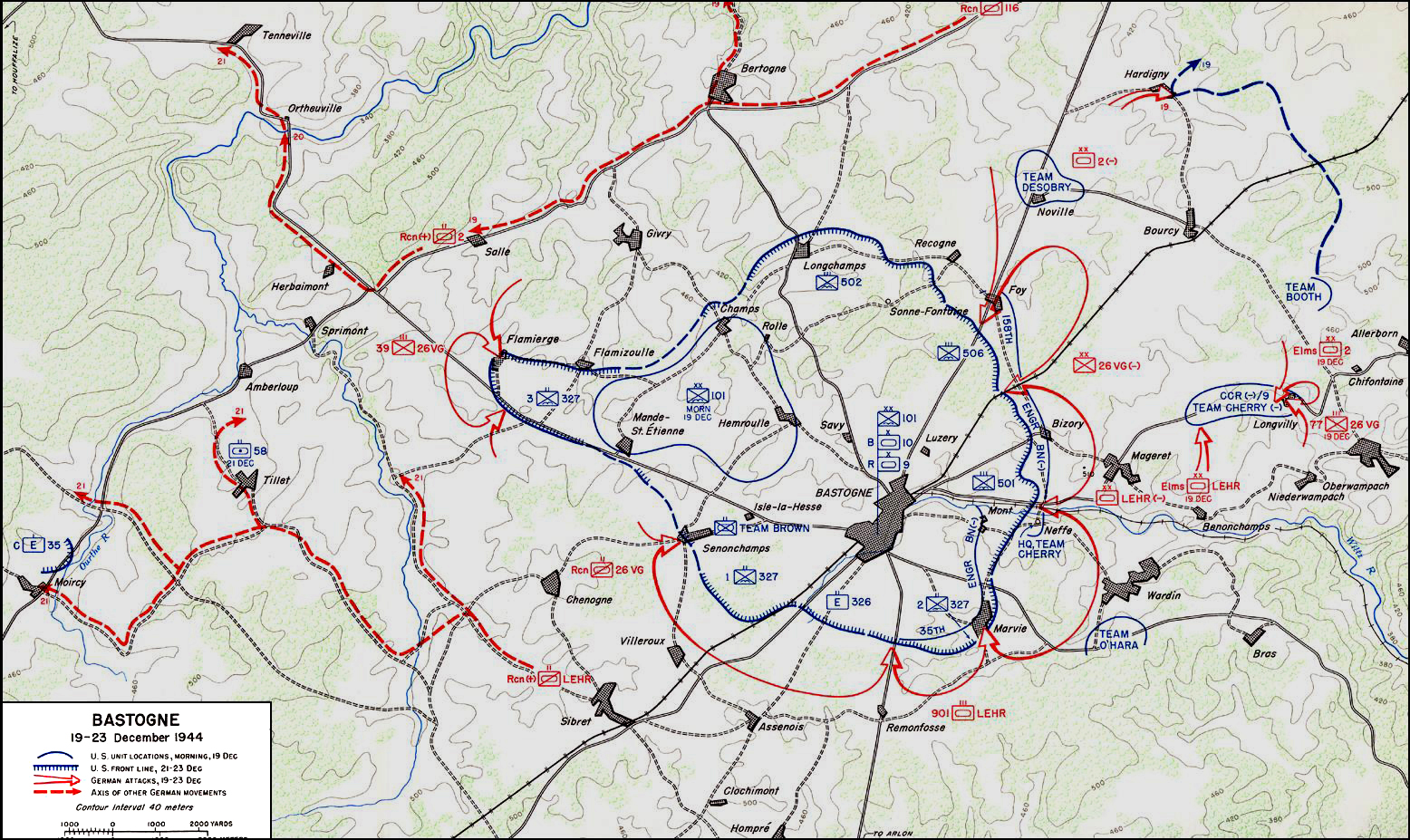
The situation in Bastogne during Christmas 1944.
Bastogne in particular is remembered for being a town under siege.  From December 20-27, 1944 members of the 82nd and 101st Airborne along with the 10th Armored Division became encircled around the town by the Nazis.  They didn't have enough supplies or ammunition because supply drops were stalled due to snow and thick fog.  Despite heavy barrages and hand to hand combat within Bastogne, it never fell to Hitler's forces.  Eventually, with the arrival of Patton's Third Army Bastogne was officially liberated.  It is probably one of the most famous battles in military history and is definitely one of the most significant of World War II.  From that moment on, Hitler didn't have a chance.

The massive Mardasson Memorial above Bastogne commemorates the besieged defenders
who held the town despite heavy Nazi offense during Christmas 1944.

The main historic site, the Mardasson Memorial Visitor Center, is currently closed for remodeling.  The Memorial itself is still open for viewing.  However, down in Bastogne itself there is a small but professionally designed exhibit called "I Was 20 in '45" presenting the perspectives of not just the combatants, but also of the civilians.  The footage from the battle and aftermath is horrific.  The recorded interviews of survivors are just as moving.  I remember in particular an interview of an old woman siting in front of her house in a blue flowered dress, thick framed glasses are perched on her nose.  She looks like just another Belgian grandmother.  In a calm voice she is telling her memories of Christmas 1944.  Her husband had gone off in the woods outside the town with his fellow resistance fighters.  He was shot and killed somewhere along the way.  Their house had been completely destroyed during one of the artillery attacks.  So, she took her newborn and hid in the woods, without food or proper clothing.  She hid there for days, almost completely frozen.  Her child didn't survive.

As we were riding along the roads and trails, past the massive monument that towered above us on the hill, I couldn't help but think that the peaceful woods which we rolled through are still pockmarked with foxholes and bomb craters.  Those pasture lands still hold battle debris and the personal effects of soldiers and civilians.  It seems like a perfect place now, but there is still blood in this landscape.  All along the way are street signs pointing to places like Noville, Bourcy, and Foy.  There'd be a marker here, a fluttering American flag there, unexploded ordinance turned monument a few kilometers later.

I realized that 70 years really isn't that long and that this route we planned wasn't so perfect after all.


Wednesday, May 15, 2013

The Place

Forty-five miles southeast of Salzburg lies a cool black lake, the surface of which barely shows a ripple.  Above the lake tower the mountains of the limestone alps, snow still resting on the heads and shoulders of the loftier peaks.  Waterfalls cascade down to the lake from unseen heights above.  Perched precariously on the slopes of one of the mountains is a village.  This village is the place.


People first began to settle this secluded spot in what is now Austria at least 7,500 years ago.  Why?  For the same reason people settle anywhere, they found a resource.  In this particular case, the resource was one of humanity's most important minerals, salt.

wikipedia.org
Salt is a necessary element to the survival of every living thing as it is responsible for water regulation in the body.  If you have too little salt in your system, you can become quite sick, even die.  Too much, and you have similar problems.  Of course, salt is important to humans for other reasons.  We put it on our food to add flavor.  Until canning and refrigeration were developed, salt was used to preserve food, especially meats, for long term storage.  So, when humans first arrived here and noticed salt brine pouring out of mountain springs, they knew they were onto something.  Initially, the salt brine was collected in earthen jars and the liquid was evaporated off, leaving the salt crystals behind.  Sometime during the Late Bronze Age, the first systematic mining began using simple tools like deer antlers.  Later, during the Iron Age, salt production had become so successful it led to the cultivation of a highly sophisticated settlement.  Hallstatt means "salt settlement," from the Celtic word Hall- meaning salt.  The village's archaeological site from the Iron Age became the type site of what is now known as Hallstatt Culture.  Hallstatt Culture is the first definitive period of the broader Celtic culture, the largest prehistoric and protohistoric people group in  Europe until its Roman takeover in the first century BC.  Salt production in Hallstatt has been carried out nearly continuously until present day.  The salt mine above the village is the oldest in the world.

View over Hallstatt from the salt mine.

Today people come to Hallstatt for a number of reasons.  Tourism, not salt, is the village's main source of income.  As the local population numbers decline, the villagers rent out rooms to tourists in their massive 18th Century alpine family dwellings.  The salt mine, while still in operation, is now also open to the public where they can learn about the prehistoric miners, geology.  You can ride mine carts and slides all while wearing the provided coveralls.  Another attraction is the Hallstatt Museum which relates the history and archaeology of Hallstatt in modern exhibitions.  Probably the most interesting sight in town is the ossuary behind the Catholic church.  Until rather recently, graves in the tiny Catholic cemetery were disinterred to make room for new tenants every 10 years.  The bones of the former occupants were cleaned, the skulls painted with their names and dates along with some flowers, and then stacked in the ossuary for display.

Besides these unique sights, the real attraction is the town itself.  It is the quintessential Alpine village.  Hallstatt will provide you perfect postcard photos no matter the direction or season.  The restaurants serve fresh fish from the lake and rivers.  As mentioned before, the accommodations are the guest rooms in the beautiful houses of the village.  The shopping is quite unique for a tourist town.  Nearly every shop sells distinctive locally made goods from ceramics, to jewelry, to soaps, to woodcrafts.  You can even buy lamps made of salt from the mine.  There are also places in town to pick up outdoor gear, for those visiting the region for its recreational offerings.


Mountain biking, backpacking, day hiking, rock climbing, and scuba diving are all popular sports in the area.  Gondolas can take visitors up to the higher peaks or people can choose one of the many alpine trails to reach these stunning places on foot.  The tight roads along with the high traffic of buses and out of town drivers doesn't lend the area well for road cycling, at least in my opinion.  But, to be quite honest, this isn't an area you want to speed through.  You will want to savor this place.

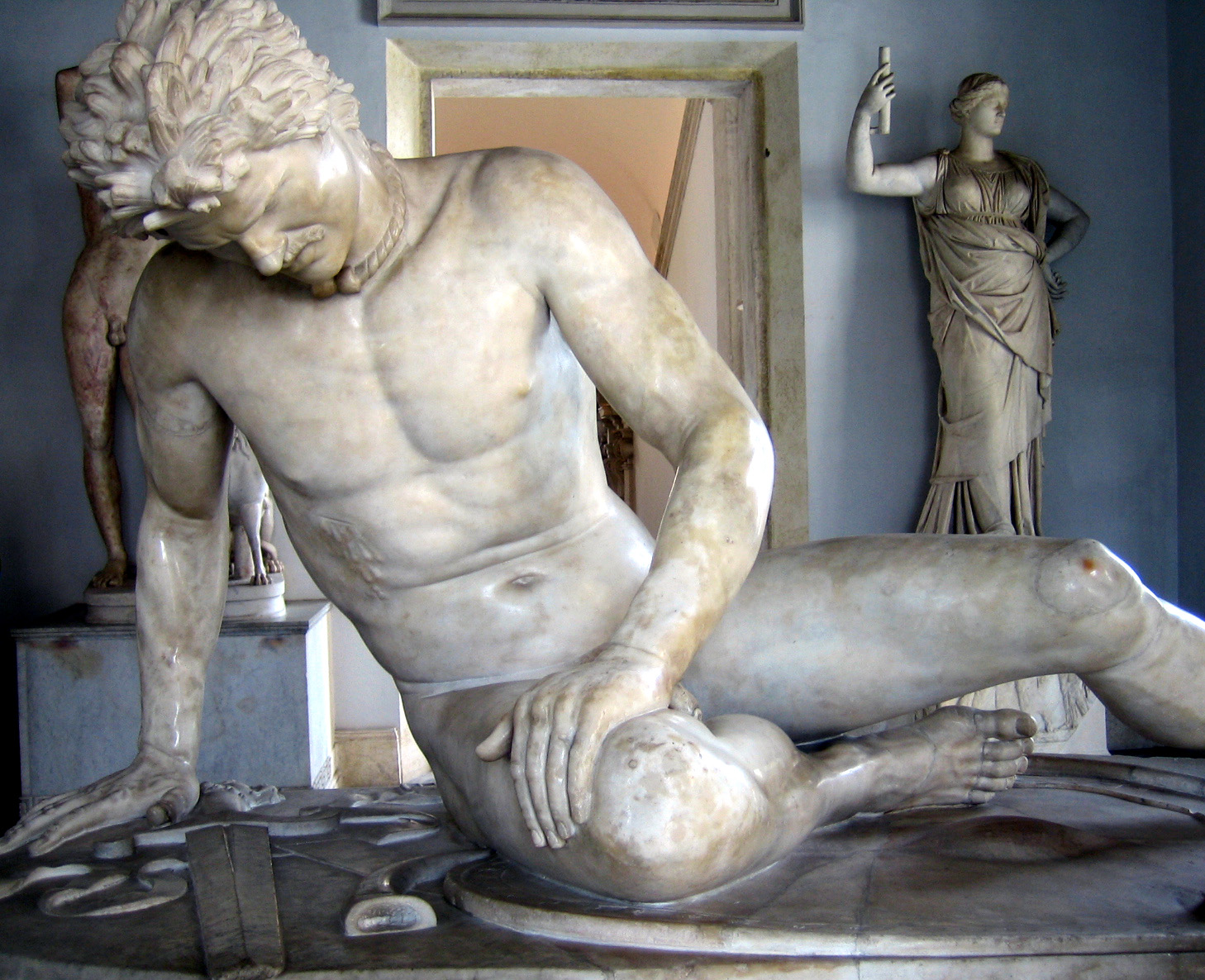
The Roman copy of the Hellenic original, The Dying Gaul.
We went to Hallstatt for the archaeology.  As a young student, it was the Celts, not the Romans, Greeks, or Egyptians that captured my interest.  Today, the terms Celt and Celtic generally refers to the non-English inhabitants and culture of the British Isles and most specifically the Irish.  However, from approximately 800 BC until 1 BC, the Celts were the dominant people of continental Europe.  Their towns, scared places, and trade networks were well established when the Romans were still herding goats on Palatine hill.  They were farmers, merchants, artisans, doctors, poets, astronomers, craftsmen, and warriors.  They were just as influential on European history as their rival Romans.  Their territory stretched from Ireland to Romania, and as far south as the Portuguese coast.  Celtic colonies have been found in the Ukraine and Turkey.  The famous Gauls of France were in fact Celts.  They sacked Rome in 390 BC and clashed with Julius Caesar during the Gallic Wars over 300 years later.  Celts founded the city of Milan in northern Italy and it was to Celts that Paul evangelized to in Galatia 50 years after the death of Christ.  Celtic influence can be seen all over the continent today, over 2,000 years after their final defeat at the battle of Alesia.  The country code for Switzerland, CH, comes from the country's romantic name- Confoederatio Helvetica.  The Helvetii were the Celts of Switzerland during Rome's expansion into the continent.  Belgium gets its name from the Belgae tribe.  While France gets its name from the Franks, a Germanic tribe, genetically a majority of the French population is Celtic and their language is a blend of Celtic languages and Latin, hence why it looks like a Latin language, but doesn't quite sound like one.  The regional languages spoken in Brittany, Breton and Gallo, are Celtic languages.  The populations of Austria, Switzerland, and Belgium are also still quite Celtic in ancestry, despite millennia of migration and conflict.  Today, the last recognizable Celtic "nations" are Ireland, Scotland, Brittany, Cornwall, Wales, and the Isle of Man.  Alas, I digress.  The point is, the Celts of the continent were a vibrant people who tend to get skipped over in the history books.  That's what happens when you don't write things down.  Although they, like the Romans, had rich histories and mythologies, this knowledge was passed down generation to generation through stories and song.  They never recorded them with the written word.  Documentation was left to their Roman conquerors who, understandably, weren't exactly objective.

Monument to the archaeology of Johann Georg Ramsauer in Hallstatt.
mshanks.com
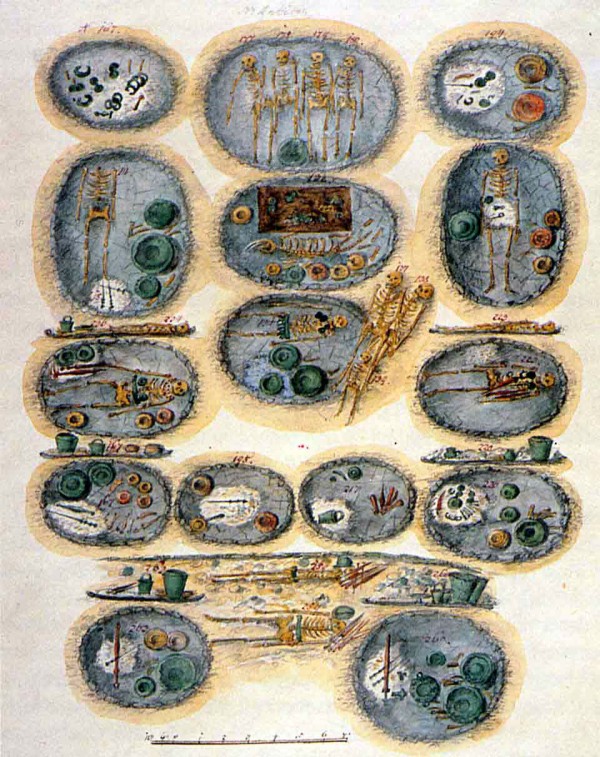
That's where archaeology and the village of Hallstatt come in.  In 1846, the salt mine foreman, Johann Georg Ramsauer, discovered an ancient grave on the hillside near the mine entrance.  He and his team subsequently excavated over 1,000 burials on the hillside.  His excavation techniques were remarkable by modern field standards.  He removed the soil layer by layer, took copious detailed notes, and created beautiful watercolors of each grave.  Hallstatt has one of the largest and richest cultural deposits from this period of prehistory and the site fleshed out our understanding of the culture that thus far had only been identified in Roman texts as a barbarian horde.  The grave goods of Hallstatt showed the Celts to be far from brutish barbarians.  Not only were the finds themselves extremely important for the narrative of Iron Age Europe, but Ramsauer's techniques helped to modernize the field of archaeology.  For those of us that have spent time studying this period, Hallstatt is a well-known name.  Since I first read about the place almost 20 years ago, it stuck in my mind.  There are very few places on earth that are not only that culturally significant, but also so stunning to look upon.

It meant a great deal to me to visit Hallstatt, mostly because of its significance in inspiring my eventual studies in history and archaeology.  There was something about that secluded place on the lake with its clues to history in the hillside and forgotten salt mine chambers that captured my imagination and eventually had me take up a trowel.  In the back of my mind, I had hoped to visit this site who's personal importance outweighed the Forum, Pompeii, the Pyramids of Giza, or the Serpent Mound.  It turned out to be even more enjoyable than I had imagined.  Besides the archaeology, all the other wonderful aspects of Hallstatt make a visit worthwhile.  I imagine that's why it is such a popular destination for people from all over the world.  In fact, it is so popular with the Chinese that there is an exact replica of the village in Huìzhōu.  Despite its popularity for tourists, Hallstatt and the region still manages to keep ahold of itself.  When the buses leave for the day, it is just a regular Austrian village.  The locals chat on the streets, boats head to and from their garages to fish the Hallstätter See, on Sundays the townsfolk can be seen wearing their dirndls and trachts.  While they no doubt tire a bit from the constant parade of foreign tourists through their town, you'd never know it.  No matter if you're stepping into a shop, restaurant or the museum you will always be met with a cheery smile.


While I'm sure to keep on traveling, I have a strong suspicion that Hallstatt, Austria has become and will remain The Place.  There have only been a couple spots to make the "must return to" list, most of them have tall mountains and clear water.  However, this place has that extra special something, something that has me saying we need to go back.  Again and again.