There I was, laying half in the mud and half out. The sky was particularly blue. The river was high, but not too high. It had been at some point, that was abundantly clear at this moment. It sounded nice though, gushing healthily along the bank and over the rocks. It was a nice day, such a nice day. The freewheel was ticking forlornly on the other side of the trail. This ride certainly didn't turn out the way I had hoped.
Time to get up. We have to get up.
The day before, something terrible had happened back home. Something that was supposed to be nothing more than a celebration of the human spirit was twisted into something evil, terror. I can't go into the why, I don't think anyone will ever be able to. Nothing can explain such a gratuitous act of cowardice.
Like so many, the attack left me reeling. Those of us who participate in endurance sports, whether we cycle or run, are a community. We all deal with the same struggles and we all, basically, have the same goals. We want to finish.
Many of the athletes were denied that chance on Monday, many have a long road of recovery ahead if they want to run again. Family, friends, passersby, and citizens of Boston were wounded or killed. Lives have been destroyed. A city is changed forever. Our great country has yet another tragedy to recover from.
But, there's one thing I know. This catastrophe will not defeat those 2013 Boston Marathon athletes and it will galvanize the running community, the endurance community in fact, to get up and keep going. I know this because many of those runners on Monday who were able to finish kept running, right to the hospitals to donate their blood. Blood from bodies that were exhausted, damaged, and pushed to their limits; bodies that needed their blood. But, those incredible athletes gave it up to help others without hesitation. That right there tells you something. I also know a lot of runners. In fact, I know more runners than non-runners. One of those runners qualified for this year's Boston. An injury kept him from going. Thank God. But, he's already declared that he'll do whatever it takes to come back from that injury so he can be there next year. He won't be the only one, that is for sure. In fact, I think we're going to see something remarkable over the next year. Something tells me that running, while already a popular sport in the United States, is going to take off. This tragedy will end up serving a purpose, it will inspire. Guaranteed.
I took off on my bike Tuesday morning because I felt helpless. A community that I care about, a community that so many of my loved ones belong to was attacked and was hurting. It still is. That bike ride was all I could do. It seemed lame at the time to pedal east for 13.1 miles and then come back. But, it's all I had. It didn't turn out the way I had hoped. Two miles from the end I was covered in dirt and a good amount of blood after falling victim to a slippery puddle of mud left over from the last flooding.
It turns out it wasn't the ride, it was getting back up, cleaning off the blood, bandaging the wounds, getting back on the bike, and pedaling home that mattered on Tuesday. That is what I had to do. It is my hope and belief that the legacy of Monday's tragedy will be the motivation for us all, athletes or not, to get up and keep going.
It's the very least we can do.
Thursday, April 18, 2013

Thursday, April 11, 2013
Roubaix Noir
Last Sunday was, of course, Paris-Roubaix, the Hell of the North. Like every edition before it, the 2013 race was full of drama, brutality, and the unexpected. The Arenberg forest is probably the most recognizable stretch of cobbles of the course. While it appears early in the race and won't usually determine the winner, it will still do some serious damage to the peloton. It's an old road. Its famous cobbles were laid when Napoleon I was tromping around the area. It was laid to service the mines lying below the surface of the forest. The 1962 world champion, Jean Stablinski, who used to work in those mines, suggested the 2.4km stretch when the race organizers were looking for more challenging roads to spruce up the race course. It's been a feature of Paris-Roubaix ever since it was added in 1968. Over time it became the iconic image of the race. A memorial to Stablinski stands at the southern end.
It's an interesting place, like no other road. Anywhere. I'm still at a loss on how to describe it in words.
So, instead I'll leave you with this, the only way I could really wrap my brain around it.
It's an interesting place, like no other road. Anywhere. I'm still at a loss on how to describe it in words.
So, instead I'll leave you with this, the only way I could really wrap my brain around it.
Wednesday, April 3, 2013
View from the Hill: A Day on the Paterberg
The moon is almost full and still sitting far above the horizon line. The sun is on its way up, however, and that orange glow is starting to appear around the edges of the frost covered hills, pastures, and orchards. The countryside is silent, except for a distant rooster announcing the start of the morning. The cows are all still warm in their barns, but the lights are on and the farmers have been hard at work for some time. The horses are out, wrapped up in their blankets and lazily munching hay while they keep one eye on those strangers walking up the road with their chairs, blankets, and warm beverages.

It's 6:30am and we're walking up the hallowed stones of the Paterberg climb. It made it's first appearance in the great Ronde in 1986 and with the 2012 the route change, it is now the final climb of the monumental race. More than likely, this is where the race will be determined. Whoever makes it up first on the final lap will likely be one of the three guys on the podium. That's thinking too far ahead at this point. The sun has barely made an appearance. That final climb won't be happening for another ten hours or so.
 We're the first people here. Arriving this early might be a little excessive, but this is probably the only chance we have for a little time in silence to take this place in. Just us and the hill.
The barriers have been up and wrapped in their advertisements for a while. The amateurs had their race yesterday, and standing here makes us wonder how things went for them at this point. Who made it up? Who didn't? Who knows.
Movement is brewing on the hill. A boy grinds the gears of his mountainbike ever so slowly up while his dad watches from below. The guy who dropped off the Porto-Johns apparently had a bit of a mishap and there's a thick layer of blue ice covering the cobbles. It's a precarious spot for walkers and mountainbikes. The boy turns around and bombs back down to begin attempt number two. The police are trickling in, a couple pause beneath the summit sign for a quick picture. Next the support crew and TV crew begin to arrive. Deep discussions in Flemish occur about camera and cable placement. The caterers pull in and immediately get their truck stuck in the slippery grass. They're followed by the paramedics and the satellite TV guy. Everyone who pulls into the field gets stuck. The paramedics in their bright yellow coats immediately jump into action, scurrying across the field to rescue the next victim of frozen dew. Tires spin and paramedics push. Some vehicles survive, others remain in the clutches of the field.
Spectators begin to arrive, ascending the pitch of the hill with varying paces. They're joined by cyclists on road bikes and mountainbikes. Some have the latest model others brought their teal steal ride purchased circa 1988. Some are wearing mismatched kits from the same era. You know, lycra gets a little threadbare in certain areas over time? Not all of them are successful, usually tipping somewhere around the blue ice field. But, as the sun climbs higher, the ice thaws and the ascents become more successful. Steam pours out of the frite truck. The rest of the police have arrived. Their captain has the best goatee we've seen in a while. They're divvying up their assignments. Apparently an agreement has been made that reinforcements will be needed near the top of the climb and around the frite/TV/beer field. Things could get a little crazy depending how the local favorites perform.
Meanwhile, there seems to be a problem with the satellite connection. Either it is the TV guy's first day on the job or there's something wrong with the equipment. He moves the dish a little to the left, then back to the right, then back to the left, and so on. So far, no luck.


The hill begins to fill up. Plastic glasses filled with Jupiler start getting handed out around 10:00am; it's never too early for pils on Ronde day. Lion of Flanders flags, both official and separatist versions, start showing up.


It's still cold. The temperatures aren't supposed to climb much higher than freezing. Everyone is bundled. We have hand and toe warmers stuck to the inside of gloves and shoes. They're just keeping things bearable for the extremities. Barely. A warm paper cone of frites holds us over around 11:00am, one of those burgers you can only find in Belgium handles the afternoon. A thermos of tea fills in the rest. Sorry, it's just too cold for beer.


The hill begins to fill up, and that's when the real characters make their appearance. Wacky costumes, decked out old folks, fan club regalia, and OPQS gear dot the hill side. Normally all of this would cause a double take, but today is Ronde day and this is perfectly normal.
For now we are anticipating the arrival of the women. Of course, no one has any idea how that race is going. Even if they were giving updates on the television and one spoke Dutch, the television still isn't working. A picture blips in for 5 seconds at a time and then cuts out again. TV guy has been MIA since earlier this morning. Every few minutes someone approaches the giant TV with an air of intent, as if they know exactly what the problem is and know exactly how to fix it. Then, they see all the wires, dishes, and unidentified boxes and turn away in defeat. A few people ask a passing cop if he can do anything. He laughs.
Just after 1:30pm the familiar song of the pace car wafts up from below the hill. The women are on their way. In a split second we're going to be the only people who know what is going on with their race. The greatest cyclist alive is competing to win her first Ronde, and only some people waiting for another race will know if she has a chance.

The women's peloton is shattered. The Vos group storms up the hill at breakneck speed, but it's a bit of a wait for the next group to make their appearance. Then, there's another group. A lone rider trickles in here and there. Those of us who are there cheer them on. Why no one seems to care about women's racing in which a phenomenon like Vos competes is beyond belief. These women are incredible. But, the real crowds don't begin to show up until the ladies are long gone. Those of us that are interested won't find out the results of their race for hours.
 We wait a little longer. The barriers fill up, even those that line the deep ditch on the other side of the road. Before we know it, the motor bikes and official cars come flying through. Then, the breakaway group arrives, charging up the hill. There's no telling if they will be leading the second time they come around. From the pace they've set they seem to hope so. The peloton, mostly together at this point, is not too far behind. The crowd goes insane. The guy standing next me insists on leaning over the barrier to slap every guy on the back that happens to ride by within reach. After Thor Hushovd gets the slap, another fan decides enough is enough and decides to explain spectating etiquette to Mr. Slaps, loudly. Mr. Slaps leaves. No more riders will be manhandled from this section of the Paterberg.
With the passing of the ambulance, we know we have another wait ahead. All eyes are back to the TV, which has finally been repaired by the missing tech. It turns out all he had to do was change the channel. The clear picture was received with a huge round of applause.
The second pass has a new set of leaders, in various states of exhaustion. The following peloton is much more fragmented than before. There's a major slow down at the summit that causes all the team cars to come to a standstill. The stragglers are forced to pass in the tight spot between the cars and the barriers. Down on this section of the hill, the fans give them space. These guys don't need anymore obstacles.

We all watch on the television as the final stage of the race begins to unfold. Cancellera pulls ahead on his own, but Sagan is hot on his tail. He wants Spartacus to do all the work, the crafty black sheep of the peloton will sit on his wheel happy to take the tow. But, before long local favorite Jurgen Roelandts begins to chase the duo and before long it becomes a trio. Ladies and gentlemen, here is your podium. All that's left is to find out in which order they'll stand. The crowd swells as those that spent the majority of the race somewhere drinking beer begin to take serious interest and push their way to the barriers. We can barely see through the forest of waving arms.
They reach the base of the Paterberg together. They pass our spot together. But, not much further up the hill a gap begins to form between Cancellera's back wheel and the front wheel of Sagan. The gap grows. A motorbike slips in between. Try as they might, they can't reel Cancellera back in.
It's done.
The rest of the peloton, now left in several bits all over the hill, is nearly forgotten by the crowd. Everyone is focused on the man on the big screen as he solos away to take his second victory of De Ronde. Sagan is handed second place by a spent Roelandts, and later on he thinks he's entitled to be handed something else. But, the crowd on the Paterberg doesn't care about about that. They're thrilled for the man that won, to see the King of the Classics making a comeback. Horns honk, bells ring, and hands clap.

Then, everyone's heading back down the hill. It seems only seconds for the once packed fields to be emptied. The interviews play on the screen without an audience. Those of us lagging behind finally find out the results of the women's race. They couldn't be better.
It's time for us to leave now. They're already tearing down the barriers, wrapping up cables, and disassembling signs. The hill is almost empty, covered in discarded paper flags and plastic cups.

The Paterberg will go back to relative anonymity, except to those wanting to experience the course for themselves on their bikes throughout the year. The only thing that hints at the glory of this climb are the little signs pointing the way for the De Ronde cycle route. The Eddy Merckx route passes this way too.
As for us, it's been ten hours and a hot shower and a hot drink are in order. But, despite our frozen fingers and toes we wouldn't have traded those ten hours for anything. The Ronde is a race like no other. It's not the Tour. Flanders is a special place and the Ronde is a special race. It's part of the identity of the country, it's a symbol of a cycling mad land. The fans with their 10:00am beer and curry ketchup burgers are something else. Their antics make us love cycling even more; if that were even possible. Their passion for the local teams and riders is a beautiful thing. Despite everything that cycling has been through, the drugs, the lies, and the fallen heros, the fans in Flanders still come out to hills like the Paterberg on Sundays in the Spring for the races. They still lean over those barriers, they still analyze the ins and outs of the route, they still don their replica jerseys and wave their flags.
Spend tens hours on hill in Flanders during the Ronde and you will learn what we learned. Cycling is still very much alive in these parts and it's not leaving anytime soon. That, in my opinion, is pretty darn inspiring.
View from the Hill from CG Inlux on Vimeo.

It's 6:30am and we're walking up the hallowed stones of the Paterberg climb. It made it's first appearance in the great Ronde in 1986 and with the 2012 the route change, it is now the final climb of the monumental race. More than likely, this is where the race will be determined. Whoever makes it up first on the final lap will likely be one of the three guys on the podium. That's thinking too far ahead at this point. The sun has barely made an appearance. That final climb won't be happening for another ten hours or so.

The barriers have been up and wrapped in their advertisements for a while. The amateurs had their race yesterday, and standing here makes us wonder how things went for them at this point. Who made it up? Who didn't? Who knows.
Movement is brewing on the hill. A boy grinds the gears of his mountainbike ever so slowly up while his dad watches from below. The guy who dropped off the Porto-Johns apparently had a bit of a mishap and there's a thick layer of blue ice covering the cobbles. It's a precarious spot for walkers and mountainbikes. The boy turns around and bombs back down to begin attempt number two. The police are trickling in, a couple pause beneath the summit sign for a quick picture. Next the support crew and TV crew begin to arrive. Deep discussions in Flemish occur about camera and cable placement. The caterers pull in and immediately get their truck stuck in the slippery grass. They're followed by the paramedics and the satellite TV guy. Everyone who pulls into the field gets stuck. The paramedics in their bright yellow coats immediately jump into action, scurrying across the field to rescue the next victim of frozen dew. Tires spin and paramedics push. Some vehicles survive, others remain in the clutches of the field.
Spectators begin to arrive, ascending the pitch of the hill with varying paces. They're joined by cyclists on road bikes and mountainbikes. Some have the latest model others brought their teal steal ride purchased circa 1988. Some are wearing mismatched kits from the same era. You know, lycra gets a little threadbare in certain areas over time? Not all of them are successful, usually tipping somewhere around the blue ice field. But, as the sun climbs higher, the ice thaws and the ascents become more successful. Steam pours out of the frite truck. The rest of the police have arrived. Their captain has the best goatee we've seen in a while. They're divvying up their assignments. Apparently an agreement has been made that reinforcements will be needed near the top of the climb and around the frite/TV/beer field. Things could get a little crazy depending how the local favorites perform.
Meanwhile, there seems to be a problem with the satellite connection. Either it is the TV guy's first day on the job or there's something wrong with the equipment. He moves the dish a little to the left, then back to the right, then back to the left, and so on. So far, no luck.


The hill begins to fill up. Plastic glasses filled with Jupiler start getting handed out around 10:00am; it's never too early for pils on Ronde day. Lion of Flanders flags, both official and separatist versions, start showing up.


It's still cold. The temperatures aren't supposed to climb much higher than freezing. Everyone is bundled. We have hand and toe warmers stuck to the inside of gloves and shoes. They're just keeping things bearable for the extremities. Barely. A warm paper cone of frites holds us over around 11:00am, one of those burgers you can only find in Belgium handles the afternoon. A thermos of tea fills in the rest. Sorry, it's just too cold for beer.


The hill begins to fill up, and that's when the real characters make their appearance. Wacky costumes, decked out old folks, fan club regalia, and OPQS gear dot the hill side. Normally all of this would cause a double take, but today is Ronde day and this is perfectly normal.
For now we are anticipating the arrival of the women. Of course, no one has any idea how that race is going. Even if they were giving updates on the television and one spoke Dutch, the television still isn't working. A picture blips in for 5 seconds at a time and then cuts out again. TV guy has been MIA since earlier this morning. Every few minutes someone approaches the giant TV with an air of intent, as if they know exactly what the problem is and know exactly how to fix it. Then, they see all the wires, dishes, and unidentified boxes and turn away in defeat. A few people ask a passing cop if he can do anything. He laughs.
Just after 1:30pm the familiar song of the pace car wafts up from below the hill. The women are on their way. In a split second we're going to be the only people who know what is going on with their race. The greatest cyclist alive is competing to win her first Ronde, and only some people waiting for another race will know if she has a chance.

The women's peloton is shattered. The Vos group storms up the hill at breakneck speed, but it's a bit of a wait for the next group to make their appearance. Then, there's another group. A lone rider trickles in here and there. Those of us who are there cheer them on. Why no one seems to care about women's racing in which a phenomenon like Vos competes is beyond belief. These women are incredible. But, the real crowds don't begin to show up until the ladies are long gone. Those of us that are interested won't find out the results of their race for hours.
 We wait a little longer. The barriers fill up, even those that line the deep ditch on the other side of the road. Before we know it, the motor bikes and official cars come flying through. Then, the breakaway group arrives, charging up the hill. There's no telling if they will be leading the second time they come around. From the pace they've set they seem to hope so. The peloton, mostly together at this point, is not too far behind. The crowd goes insane. The guy standing next me insists on leaning over the barrier to slap every guy on the back that happens to ride by within reach. After Thor Hushovd gets the slap, another fan decides enough is enough and decides to explain spectating etiquette to Mr. Slaps, loudly. Mr. Slaps leaves. No more riders will be manhandled from this section of the Paterberg.
With the passing of the ambulance, we know we have another wait ahead. All eyes are back to the TV, which has finally been repaired by the missing tech. It turns out all he had to do was change the channel. The clear picture was received with a huge round of applause.
The second pass has a new set of leaders, in various states of exhaustion. The following peloton is much more fragmented than before. There's a major slow down at the summit that causes all the team cars to come to a standstill. The stragglers are forced to pass in the tight spot between the cars and the barriers. Down on this section of the hill, the fans give them space. These guys don't need anymore obstacles.

We all watch on the television as the final stage of the race begins to unfold. Cancellera pulls ahead on his own, but Sagan is hot on his tail. He wants Spartacus to do all the work, the crafty black sheep of the peloton will sit on his wheel happy to take the tow. But, before long local favorite Jurgen Roelandts begins to chase the duo and before long it becomes a trio. Ladies and gentlemen, here is your podium. All that's left is to find out in which order they'll stand. The crowd swells as those that spent the majority of the race somewhere drinking beer begin to take serious interest and push their way to the barriers. We can barely see through the forest of waving arms.
They reach the base of the Paterberg together. They pass our spot together. But, not much further up the hill a gap begins to form between Cancellera's back wheel and the front wheel of Sagan. The gap grows. A motorbike slips in between. Try as they might, they can't reel Cancellera back in.
It's done.
The rest of the peloton, now left in several bits all over the hill, is nearly forgotten by the crowd. Everyone is focused on the man on the big screen as he solos away to take his second victory of De Ronde. Sagan is handed second place by a spent Roelandts, and later on he thinks he's entitled to be handed something else. But, the crowd on the Paterberg doesn't care about about that. They're thrilled for the man that won, to see the King of the Classics making a comeback. Horns honk, bells ring, and hands clap.

It's time for us to leave now. They're already tearing down the barriers, wrapping up cables, and disassembling signs. The hill is almost empty, covered in discarded paper flags and plastic cups.

The Paterberg will go back to relative anonymity, except to those wanting to experience the course for themselves on their bikes throughout the year. The only thing that hints at the glory of this climb are the little signs pointing the way for the De Ronde cycle route. The Eddy Merckx route passes this way too.
As for us, it's been ten hours and a hot shower and a hot drink are in order. But, despite our frozen fingers and toes we wouldn't have traded those ten hours for anything. The Ronde is a race like no other. It's not the Tour. Flanders is a special place and the Ronde is a special race. It's part of the identity of the country, it's a symbol of a cycling mad land. The fans with their 10:00am beer and curry ketchup burgers are something else. Their antics make us love cycling even more; if that were even possible. Their passion for the local teams and riders is a beautiful thing. Despite everything that cycling has been through, the drugs, the lies, and the fallen heros, the fans in Flanders still come out to hills like the Paterberg on Sundays in the Spring for the races. They still lean over those barriers, they still analyze the ins and outs of the route, they still don their replica jerseys and wave their flags.
Spend tens hours on hill in Flanders during the Ronde and you will learn what we learned. Cycling is still very much alive in these parts and it's not leaving anytime soon. That, in my opinion, is pretty darn inspiring.
View from the Hill from CG Inlux on Vimeo.
Wednesday, March 27, 2013
Challenge Accepted
This year, from the very start, I decided I would devote my time and energy to getting fit. Seriously. While dropping pounds is half the goal, being able to get out and pedal the terrain (in various European locales) with some form of satisfaction was the other half. By the time Fall fades into winter I want to be able to look back and say that 2013 was the year of the bike and it was good.
Despite the fact that Winter has yet to fade into Spring, the first quarter of the year has been pretty darn pleasing. Sure, about 90% of my riding has been on the trainer, but my numbers are all looking positive. A significant amount of 2012 holiday poundage has been kicked to the curb, my resting heart rate is waaaaay down, and road performance is way up on those rare occasions that my bike and I actually do get outside. To top it off, for the first time since my brief childhood careers in equestrian and soccer I actually have some definition in my legs. It feels good to see results.
So, when a Rapha newsletter landed in my Inbox announcing a global 100km ride for women on July 7th, I thought, "Hey, this is a good opportunity to keep my motivation up, train with an actual purpose, and be involved in an event with other women that spans the globe." I filled out the form and the training officially begins next week.
The cool thing about this event is that it is completely doable, no matter where you live or what kind of cyclist you are now. Yes, Rapha is sending 100 women to ride the Etape du Tour on July 7th to ride 100km. But, that's not the point. The point is to get women everywhere to ride 100km together on the same day. Let's face it, cycling is still very much a boys' club. If it wasn't you'd be able to watch women's races, the lady pros would be able to make ends meet, and the rest of us would would have access to the equipment we need without having to place special orders or settling for a bunch of pink stuff we don't really like. Perhaps we have to jump up and down and shout in one massive group to get the industry's attention. We're here, we ride, and we don't plan on leaving any time soon!
I hope you'd like join in with the jumping and shouting, or at least the pedaling.
100 kilometers. Sounds like a lot, but let's convert that to the old imperial system. It's really only about 62.1 miles. For those that ride daily, 62.1 miles isn't a big deal. For those that ride less than that but frequently, this challenge will help step things up a bit. For those that don't ride very often, but have an interest in spending more time on the bike this is a completely realistic goal and the perfect way to increase those miles. There are several ways to train for it depending on your fitness level and schedule. Training apps, like Motivo, have programs designed for 100km rides. Google will pull up even more. Picking the right one is completely up to you; they anywhere vary from 4 week programs to 15 week. I opted for a 12 week one that allows me to work around our travel schedule. For those that have more time for a higher frequency of long rides, a short program may be a good fit.
Well, however we prepare for it, the cool part is that we won't be alone in the the preparation. I'll be training for my version of the Women's 100 taking place in Luxembourg and Germany. Other women will be training in France, Italy, Britain, the United States, and elsewhere. Some will be riding solo, some with a friend, some with a group. All of us will be riding together on July 7th. In the meantime, we'll be tweeting, taking Instagram photos, and blogging about the preparation experience using the #womens100 hashtag. When you sign up with Rapha, they'll send you the occasional newsletter. There are also a handful of riders doing the Etape who are the sponsored Rapha documentarians The links to their stuff are available through the website, the newsletters, and the Facebook event.
I'll keep the training documentation to a minimum here on Relish, but will be posting the occasional update via Twitter and Instagram. I hope you will consider joining in too. Remember, July 7th, 100 kilometeres, no speed or location requirements. It's a great opportunity to support and be a part of the women's cycling community.
See you on the 7th!
Despite the fact that Winter has yet to fade into Spring, the first quarter of the year has been pretty darn pleasing. Sure, about 90% of my riding has been on the trainer, but my numbers are all looking positive. A significant amount of 2012 holiday poundage has been kicked to the curb, my resting heart rate is waaaaay down, and road performance is way up on those rare occasions that my bike and I actually do get outside. To top it off, for the first time since my brief childhood careers in equestrian and soccer I actually have some definition in my legs. It feels good to see results.
So, when a Rapha newsletter landed in my Inbox announcing a global 100km ride for women on July 7th, I thought, "Hey, this is a good opportunity to keep my motivation up, train with an actual purpose, and be involved in an event with other women that spans the globe." I filled out the form and the training officially begins next week.
 |
| www.rapha.cc |
I hope you'd like join in with the jumping and shouting, or at least the pedaling.
100 kilometers. Sounds like a lot, but let's convert that to the old imperial system. It's really only about 62.1 miles. For those that ride daily, 62.1 miles isn't a big deal. For those that ride less than that but frequently, this challenge will help step things up a bit. For those that don't ride very often, but have an interest in spending more time on the bike this is a completely realistic goal and the perfect way to increase those miles. There are several ways to train for it depending on your fitness level and schedule. Training apps, like Motivo, have programs designed for 100km rides. Google will pull up even more. Picking the right one is completely up to you; they anywhere vary from 4 week programs to 15 week. I opted for a 12 week one that allows me to work around our travel schedule. For those that have more time for a higher frequency of long rides, a short program may be a good fit.
Well, however we prepare for it, the cool part is that we won't be alone in the the preparation. I'll be training for my version of the Women's 100 taking place in Luxembourg and Germany. Other women will be training in France, Italy, Britain, the United States, and elsewhere. Some will be riding solo, some with a friend, some with a group. All of us will be riding together on July 7th. In the meantime, we'll be tweeting, taking Instagram photos, and blogging about the preparation experience using the #womens100 hashtag. When you sign up with Rapha, they'll send you the occasional newsletter. There are also a handful of riders doing the Etape who are the sponsored Rapha documentarians The links to their stuff are available through the website, the newsletters, and the Facebook event.
I'll keep the training documentation to a minimum here on Relish, but will be posting the occasional update via Twitter and Instagram. I hope you will consider joining in too. Remember, July 7th, 100 kilometeres, no speed or location requirements. It's a great opportunity to support and be a part of the women's cycling community.
See you on the 7th!
Wednesday, March 20, 2013
Real Ale, Bathroom Graffiti, Buried Alleys, & Fajitas
We were standing at the customs desk trying to look as confident as possible while this portly and rather grumpy Belgian police officer decided our fate. Would we be hearing the wonderful sound of a click and slam of the stamp that would let us return to our house or the fateful words "Please come with me" while being lead into some sterile security office to begin deportation proceedings? He read over our papers, very slowly. He looked at the passports again. He looked at us. Again. We held our breath. How did this happen?
Rewind a few days back.

Edinburgh was named Travel Destination of the Year at the Travel Awards last year and for good reason. It's not a massive city. With a centrally located train station, walkable and bikeable streets, unique attractions, lots of food and drink options, and citizens that may be some of the nicest people in Europe you really couldn't go wrong.
We spent last weekend in Edinburgh exploring nooks and crannies, most of which were food and beverage related. So, you want to know what there is in Edinburgh that is worth risking deportation for? Well, here you go.
 Pubs. Good pubs are the heart and soul of this city and there are plenty to choose from. We had the pleasure of being pointed in the right direction by some locals so we were thankfully introduced to a couple of gems. First off is The Wally Dug on Northumberland Street. It's the perfect example for why you have to look below street level in Britain. There are some great finds under the stairs. The Wally Dug is one of them. Most of the ales on tap are Belhaven, and there are some excellent selections from their stock. They also have some craft cask ales available, which are certainly worth a taste. Cask ales (as opposed to those served from kegs) are something special and not a brew you're going to find in very many places outside of the United Kingdom. Unfiltered, unpasteurized, and served without additional nitrogen or carbon dioxide pressure, they're not going to taste quite like anything else. Sometimes they come out a little warmer than you'd expect, and that's something to get used to. But, with all the variety of ales to be had you're bound to find one or six that you enjoy. I do love my Belgian brews, but, wow, it was nice to have a stout again!
 If you happen to be in Old Town, then another great option (and this one is my favorite) is the Jolly Judge tucked in, up and around James Court, one of the famous closes or alleyways. It's another one of those places under the stairs, with a warm fire and an excellent selection of cask ales, ciders, and whiskies. The atmosphere is spot on. It was awfully tempting to spend the day there. That's just two places. There were several others that were just as lovely. Milnes Bar, one of the Taylor Walker pubs, comes to mind as well. Wherever you end up grabbing a pint, I'm pretty certain you'll discover one commonality (besides the beautiful ales). The folks that tend bar in Edinburgh really are a wonderful lot. They're happy to have you in their establishment, they'll serve you with a smile, and will go out of their way to make recommendations if you need one. Pubs in Edinburgh are the way pubs are supposed to be.
 Ok, if you're not into ales or whiskies then a coffee shop may be a better choice. The Elephant House is probably one of the most famous coffee shops in the world. To be honest, I hadn't heard of it. But, Harry Potter fans probably have. Apparently, this is the spot where J.K. Rowling penned a good portion of her novels. While the coffee is pretty good, the pastries look irresistible, and the atmosphere is unique, the bathrooms are the real draw. No, seriously. Normally, when I step into a restroom and see the walls have been covered (and I mean COVERED) in graffiti I feel like I'll need to wash my hands twice. At least. But, after glancing around I realized that it wasn't vulgarities and phone numbers scrawled on the walls, but beautiful and sweet messages of thanks from all over the world for lives enriched by literature. It's worth a peek.
 Now, Edinburgh has lots to see and do. Capital cities are like that. There are all sorts of museums. Museums on whisky, museums on weaving, museums on torture. Of course, there's also the giant castle sitting on top of an extinct volcano smack dab in the middle of everything. I'm sure they're all fascinating, but you'd need more than a weekend to see every attraction. One thing we did get in, which I highly recommend, is definitely one of the most unique spots I've ever visited.
The Real Mary King's Close tour takes visitors underneath modern day Old Town (yeah, I know that sounds confusing). This tour isn't your typical history tour. You actually go underneath the city into the old house foundations and actual streets that were built over during the construction of the Royal Exchange. It's a bit complicated to explain, but basically when they decided to build the Exchange they determined it would save time, money, and materials just to level off the buildings that were already there and use their foundations as the foundations for the Exchange. Most of these underground spaces were filled in or can't be accessed, but there is a section that was reopened to the public in 2003 that provides a space to explain 15th and 16th Century life in Edinburgh. While the tour has its cheesy moments, ok, it has a lot of cheesy moments, it is quite fascinating to walk through streets trapped in time. It isn't something for everyone. The tour is dark, dusty, and a bit tricky to maneuver. But, in my opinion it's worth checking out. You won't find something like it anywhere else. Huge thanks to the friends that led us down there.
 Last but not least, food. You're going to think I'm nuts. Maybe it's the fact I haven't encountered a respectable bowl of salsa in a year, but in all seriousness take a break from the burgers, fish & chips, and haggis and head over to Rose Street for some Mexican at Miro's Cantina. Scottish Mexican food may seem like the most bizarre idea ever, but there isn't a hint of Scotland about the place (save some of the servers). The nachos are to die for. There isn't a drop of freakishly liquid fluorescent orange cheese sauce anywhere. The fajitas, well, it could be my flavor starved palate talking, but they were the best I've had anywhere. Those alone were worth risking deportation for. I will hold on to that memory for a long time.
So, obviously, we did make it back to our house free and clear, not that I wouldn't make telling you about Scottish Mexican food a priority while sitting in a Belgian prison. Turns out that if one guy in the Luxembourg foreign residency office gets sick then all of us who depend on the necessary paperwork are up a creek. Thankfully, calls were made and the suspicious looking Americans were stamped through with an extra glare thrown in. Oh well, even if things hadn't turned out, it would be difficult to regret those fajitas.
I can see why Edinburgh gets such rave reviews. There are few places that live up to the hype, but the capital of Scotland definitely meets and exceeds expectations. My only regret is that we didn't have more time. Hopefully, we'll be able to make it back (legally) some day to see even more of this fabulous old city. Edinburgh has a great deal to offer the tourist and if you're heading to the UK, please put it at the top of your list. You won't be disappointed.
Rewind a few days back.

We spent last weekend in Edinburgh exploring nooks and crannies, most of which were food and beverage related. So, you want to know what there is in Edinburgh that is worth risking deportation for? Well, here you go.

 If you happen to be in Old Town, then another great option (and this one is my favorite) is the Jolly Judge tucked in, up and around James Court, one of the famous closes or alleyways. It's another one of those places under the stairs, with a warm fire and an excellent selection of cask ales, ciders, and whiskies. The atmosphere is spot on. It was awfully tempting to spend the day there. That's just two places. There were several others that were just as lovely. Milnes Bar, one of the Taylor Walker pubs, comes to mind as well. Wherever you end up grabbing a pint, I'm pretty certain you'll discover one commonality (besides the beautiful ales). The folks that tend bar in Edinburgh really are a wonderful lot. They're happy to have you in their establishment, they'll serve you with a smile, and will go out of their way to make recommendations if you need one. Pubs in Edinburgh are the way pubs are supposed to be.

The Real Mary King's Close tour takes visitors underneath modern day Old Town (yeah, I know that sounds confusing). This tour isn't your typical history tour. You actually go underneath the city into the old house foundations and actual streets that were built over during the construction of the Royal Exchange. It's a bit complicated to explain, but basically when they decided to build the Exchange they determined it would save time, money, and materials just to level off the buildings that were already there and use their foundations as the foundations for the Exchange. Most of these underground spaces were filled in or can't be accessed, but there is a section that was reopened to the public in 2003 that provides a space to explain 15th and 16th Century life in Edinburgh. While the tour has its cheesy moments, ok, it has a lot of cheesy moments, it is quite fascinating to walk through streets trapped in time. It isn't something for everyone. The tour is dark, dusty, and a bit tricky to maneuver. But, in my opinion it's worth checking out. You won't find something like it anywhere else. Huge thanks to the friends that led us down there.

So, obviously, we did make it back to our house free and clear, not that I wouldn't make telling you about Scottish Mexican food a priority while sitting in a Belgian prison. Turns out that if one guy in the Luxembourg foreign residency office gets sick then all of us who depend on the necessary paperwork are up a creek. Thankfully, calls were made and the suspicious looking Americans were stamped through with an extra glare thrown in. Oh well, even if things hadn't turned out, it would be difficult to regret those fajitas.
I can see why Edinburgh gets such rave reviews. There are few places that live up to the hype, but the capital of Scotland definitely meets and exceeds expectations. My only regret is that we didn't have more time. Hopefully, we'll be able to make it back (legally) some day to see even more of this fabulous old city. Edinburgh has a great deal to offer the tourist and if you're heading to the UK, please put it at the top of your list. You won't be disappointed.
Tuesday, March 12, 2013
Searching for the Perfect Saddle
Comfort.
Let's face it, that is probably the biggest factor in how much someone participates and enjoys cycling. If getting on a bicycle causes pain somewhere, most people don't want to get on a bike very much. The story goes as follows: person remembers that riding their bike was a lot of fun when they were a kid, they dust off their old MTB/roadie/cruiser and pump up the tires, they go for a ride Saturday or Sunday afternoon, everything goes well at first, then there's this pain in the hands/feet/knees/shoulders/rear, they go home, it takes a day or two for the pain to subside, they forget about the pain, they ride again some other weekend, the pain comes back, this happens a few times, so they roll the old bike back in the garage, and they call it a day. Riding a bike was fun when they were a kid, but unless they're just going for an easy spin in the neighborhood or the park, it's not really for them anymore. Cycling becomes just something to do with the kids for a couple days here and there in the summer. The bike spends most of its time with soggy tires and a layer of dust on the saddle. *Sniff
What a lot of people don't realize, even people that do a lot of riding, is that serious discomfort on a bicycle isn't supposed to be a part of the activity. Unless you're really pushing yourself physically or riding for a long period of time or in adverse conditions, you shouldn't be "suffering." Your bike itself shouldn't cause you pain.
Now, there are a lot of reasons why you could be uncomfortable on your bike depending on what hurts. Getting a proper bike fit can solve a lot of those problems. But, one of the most common problems, especially for women, is pain in the rear. While sometimes this is caused by saddle height or position, usually the real problem is the saddle itself. For women that ride road or mountain bikes, this problem is even more common than it is for those who ride upright commuters, city bikes, or cruisers. Why? Because the saddles don't fit.
Usually, we figure out pretty quickly that our saddles are the problem, but oftentimes we don't know why they are a problem. Many people think that there isn't enough padding so they switch out the stock saddle for one with more squish. However, the most common reason for the discomfort is that the saddle is too narrow. Ok, let's talk anatomy for a minute.
When we sit down, our weight is distributed over two points of bone on our pelvis called the ischial tuberosities or more commonly "sit bones." If we're not sitting correctly, for example slouching, that puts pressure on parts of the body that aren't supposed to be weight supporting- like the lower back. When we're on a bike saddle that doesn't match up with our sit bones, the pressure is often on our tender regions and can cause all sorts of unpleasant sensations.
The thing is, most people don't know this, so they suffer along for years on saddles that don't fit, women especially. Why? Because most saddles out there are designed for people with a smaller distance between their sit bones- men. Yep, one of the things that set men and women apart are their pelvises. For obvious reasons, women generally have a wider pelvis and therefore a greater distance between their ischial tuberosities. The distance between your sit bones has nothing to do with your weight or whether you've had children (though women may see a change in distance after childbirth). Even if you are super skinny, you can still have a sit bone distance that would be called wide. It's just your skeletal structure. Oh by the way, fellas, you can have wider sit bones too.
If your saddle isn't supporting your sit bones, you end up sitting on your nerves and soft tissue which over time can cause serious pain or numbness. For me, a long ride on a narrow saddle causes a tingling sensation and pain in my right leg that eventually reaches my foot. A nerve is being pinched. If this sounds familiar, you may be using a saddle that is too narrow as well.
So, the first step to saddle comfort is getting one that is the right width. But, you have to find out what the correct width is, right? To do this you have a couple of options. No. 1 go to your local shop that does saddle fits (Specialized dealers often have a nifty setup for this purpose) or No. 2 figure it out yourself. If No. 2 is what you are left with, there are a few ways to go about this. You can put a piece of tin foil on a carpeted step and rock back and forth on your tuberocities to leave an impression. Or you can do something similiar with memory foam, damp tissue, or a bag filled with a little flour. I tried just about all those methods before I was able to get a clear impression of my sit bones. After I had an impression, I measured the distance between the two centers of the impressions in millimeters. That is my sit bone measurement. Lo and behold, I finally knew exactly why I was getting pain in my right leg. Nearly all of my saddles were too narrow, a good 20 millimeters too narrow. All my weight was being supported by my soft tissue while my sit bones were in contact with just the edges of the saddle.
Next, I set about locating road saddles that matched up with my measurements. Reading through forums and getting advice from other ladies directed me to a few different companies who made saddles with the dimensions that I needed. It turns out, that while many saddle companies make women specific models, not many make ones that would actually work. In many cases, they're just a smidge wider with a touch of pink in the design. While those saddles may work for women with narrow sit bones, they aren't going to help most women out anymore than the mens saddles. My measurements fell on the wider end of the range so that left me with only a few options. From there, I narrowed my choices down to two companies- Selle Italia and Brooks. There were a few other choices out there, but they either fell right on the line of width (I wanted to have some wiggle room) or I just didn't care for their appearance.
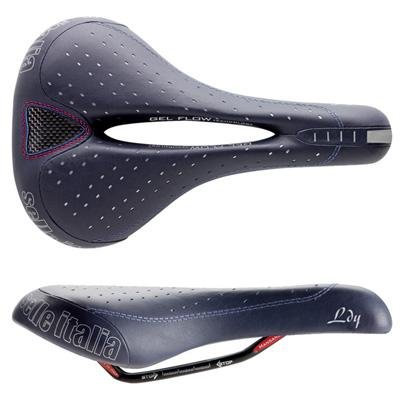
Selle Italia's Lady Gel Flow seemed to be the best option from the company's range. I heard a lot of good things about it and thought it's appearance would match up well with a road bike. So, I picked one up. Saddles are like shoes. You won't know it fits until you try them. Alas, while this saddle works great for a lot of women out there, we didn't get along very well. I tried it out over a week's time on long and short distances and each ride resulted in discomfort. While the width was right, other aspects of the saddle didn't work well for me. One of those things was actually the length. The shorter nose limited where I could sit forward and back. Another problem was the padding. For me, the three layers of plastic, gel, and leather were too much. There was too much give and not enough support.
So, my next option was something from the Brooks line. However, before I committed to the granddaddy of saddles, I had an idea. I already own a leather saddle with the same dimensions as the Brooks B17 model. It was on the Varsity. So, I popped it off the Varsity (which won't come out of the garage until the weather clears anyway) and set it up on the Revenio. While it certainly isn't a traditional road saddle, it had the advantage of having the correct dimensions while lacking all that extra padding. Presto! We had a winner! While it didn't have all the bells and whistles of the other saddles out there, it was exactly what I needed to have a comfortable ride.
Let's face it, that is probably the biggest factor in how much someone participates and enjoys cycling. If getting on a bicycle causes pain somewhere, most people don't want to get on a bike very much. The story goes as follows: person remembers that riding their bike was a lot of fun when they were a kid, they dust off their old MTB/roadie/cruiser and pump up the tires, they go for a ride Saturday or Sunday afternoon, everything goes well at first, then there's this pain in the hands/feet/knees/shoulders/rear, they go home, it takes a day or two for the pain to subside, they forget about the pain, they ride again some other weekend, the pain comes back, this happens a few times, so they roll the old bike back in the garage, and they call it a day. Riding a bike was fun when they were a kid, but unless they're just going for an easy spin in the neighborhood or the park, it's not really for them anymore. Cycling becomes just something to do with the kids for a couple days here and there in the summer. The bike spends most of its time with soggy tires and a layer of dust on the saddle. *Sniff
What a lot of people don't realize, even people that do a lot of riding, is that serious discomfort on a bicycle isn't supposed to be a part of the activity. Unless you're really pushing yourself physically or riding for a long period of time or in adverse conditions, you shouldn't be "suffering." Your bike itself shouldn't cause you pain.
Now, there are a lot of reasons why you could be uncomfortable on your bike depending on what hurts. Getting a proper bike fit can solve a lot of those problems. But, one of the most common problems, especially for women, is pain in the rear. While sometimes this is caused by saddle height or position, usually the real problem is the saddle itself. For women that ride road or mountain bikes, this problem is even more common than it is for those who ride upright commuters, city bikes, or cruisers. Why? Because the saddles don't fit.
Usually, we figure out pretty quickly that our saddles are the problem, but oftentimes we don't know why they are a problem. Many people think that there isn't enough padding so they switch out the stock saddle for one with more squish. However, the most common reason for the discomfort is that the saddle is too narrow. Ok, let's talk anatomy for a minute.
 |
| http://yogainthemix.files.wordpress.com/ |
The thing is, most people don't know this, so they suffer along for years on saddles that don't fit, women especially. Why? Because most saddles out there are designed for people with a smaller distance between their sit bones- men. Yep, one of the things that set men and women apart are their pelvises. For obvious reasons, women generally have a wider pelvis and therefore a greater distance between their ischial tuberosities. The distance between your sit bones has nothing to do with your weight or whether you've had children (though women may see a change in distance after childbirth). Even if you are super skinny, you can still have a sit bone distance that would be called wide. It's just your skeletal structure. Oh by the way, fellas, you can have wider sit bones too.
If your saddle isn't supporting your sit bones, you end up sitting on your nerves and soft tissue which over time can cause serious pain or numbness. For me, a long ride on a narrow saddle causes a tingling sensation and pain in my right leg that eventually reaches my foot. A nerve is being pinched. If this sounds familiar, you may be using a saddle that is too narrow as well.
So, the first step to saddle comfort is getting one that is the right width. But, you have to find out what the correct width is, right? To do this you have a couple of options. No. 1 go to your local shop that does saddle fits (Specialized dealers often have a nifty setup for this purpose) or No. 2 figure it out yourself. If No. 2 is what you are left with, there are a few ways to go about this. You can put a piece of tin foil on a carpeted step and rock back and forth on your tuberocities to leave an impression. Or you can do something similiar with memory foam, damp tissue, or a bag filled with a little flour. I tried just about all those methods before I was able to get a clear impression of my sit bones. After I had an impression, I measured the distance between the two centers of the impressions in millimeters. That is my sit bone measurement. Lo and behold, I finally knew exactly why I was getting pain in my right leg. Nearly all of my saddles were too narrow, a good 20 millimeters too narrow. All my weight was being supported by my soft tissue while my sit bones were in contact with just the edges of the saddle.
Next, I set about locating road saddles that matched up with my measurements. Reading through forums and getting advice from other ladies directed me to a few different companies who made saddles with the dimensions that I needed. It turns out, that while many saddle companies make women specific models, not many make ones that would actually work. In many cases, they're just a smidge wider with a touch of pink in the design. While those saddles may work for women with narrow sit bones, they aren't going to help most women out anymore than the mens saddles. My measurements fell on the wider end of the range so that left me with only a few options. From there, I narrowed my choices down to two companies- Selle Italia and Brooks. There were a few other choices out there, but they either fell right on the line of width (I wanted to have some wiggle room) or I just didn't care for their appearance.
 |
| amazon.com |
Selle Italia's Lady Gel Flow seemed to be the best option from the company's range. I heard a lot of good things about it and thought it's appearance would match up well with a road bike. So, I picked one up. Saddles are like shoes. You won't know it fits until you try them. Alas, while this saddle works great for a lot of women out there, we didn't get along very well. I tried it out over a week's time on long and short distances and each ride resulted in discomfort. While the width was right, other aspects of the saddle didn't work well for me. One of those things was actually the length. The shorter nose limited where I could sit forward and back. Another problem was the padding. For me, the three layers of plastic, gel, and leather were too much. There was too much give and not enough support.
So, my next option was something from the Brooks line. However, before I committed to the granddaddy of saddles, I had an idea. I already own a leather saddle with the same dimensions as the Brooks B17 model. It was on the Varsity. So, I popped it off the Varsity (which won't come out of the garage until the weather clears anyway) and set it up on the Revenio. While it certainly isn't a traditional road saddle, it had the advantage of having the correct dimensions while lacking all that extra padding. Presto! We had a winner! While it didn't have all the bells and whistles of the other saddles out there, it was exactly what I needed to have a comfortable ride.
 |
| www.brooksengland.com |
Now that I know this style is what works, I'll be putting an order in for a Brooks B17 in black. As comfy as the Varsity's saddle is, brown just doesn't work.
Some of you may be saying, "Gah! How could you put a heavy old school Brooks on your modern road bike?" Well, yes, Brooks' saddles are much heavier than other road saddles out there. But, I'm a recreational cyclist who has no interest in getting up a hill or past a line before anyone else. My bike is a base aluminum model. It's not the fastest nor the lightest to begin with. As to the style, well attractiveness is in the eye of the beholder and I happen to like the vintage look. In fact, my husband's Ridley Icarus came stock with a riveted saddle and it looks just fine. But the bottom line is, this saddle is the most compatible for my needs and comfort is the ultimate goal. On the plus side, Brooks saddles have an extremely long life so not only will it be comfortable, it will basically last forever. It will probably outlast the bike itself.
The way I look at it, finding the right bicycle saddle is like finding your soul mate. For some of us, it doesn't take very long and they're the first one we meet. But, for most of us, it takes a little searching and a little "dating around." Eventually, if we keep looking, the right match will turn up. It may not be one that everyone else agrees with or likes, some may even say it's unattractive. But, as long as the two of you are happy together, that's all that matters.
Tuesday, March 5, 2013
Revving Up for The Ronde: A Brief Stop in Oudenaarde

It's about 25 days until one of the biggest races on the Spring calendar, the Ronde van Vlaanderen, the Tour of Flanders. Of course, we have a few races going on between now and then; Paris-Nice, Tirreno Adriatico, and the Volta Ciclista a Catalunya are just a few of the major contests in March. But, in Oudenaarde, Belgium all thoughts are fixed on the Ronde. The promo flags are up on lamp posts around the town center and the roads are positively cluttered with weekend warriors testing their mettle on cobbles and climbs.
 |
| The region's fondness for Tom Boonen is highlighted throughout the museum. |
Your visit, which will cost 8€ per person, begins with a 13 minute film showing footage from Rondes of the past, highlighting the cobbled sections, the most successful riders (especially if they're Belgian), and some of the carnage. Afterwards, the doors open into the exhibit space which provides everything you could possibly want to know about the history of this race and Belgian cycling. Alas, most of the information is only in Dutch, but you will find a bit here and there translated to French and a little in English. Upon admission you will receive a brief English synopsis of the museum if you desire. It doesn't really matter, because most items are self-explanatory. There are several opportunities for children and adults to play games and "test ride" some cobbles. You can test your knowledge of the Ronde with a 84 question quiz. I'm afraid my performance was abysmal. The major climbs are broken down into in-depth descriptions, the history of nutrition in professional cycling is explained, and artifacts from riders, teams, and the media are everywhere. A fair amount of money went into this museum and it shows. You can finish your visit with a picture on the podium with Tom Boonen, if desired. All in all, I thought the museum was excellent. I would have liked a little more English in some places, but it is a museum in Flanders, after all. The only thing I found to be a bit odd was the explanation of why men make better bike racers than women. In my opinion comparing the physical performance of men vs. women has a taste of backward ignorance, but that could just be my inner feminist coming out...

Anyway, exiting the museum takes you right into the gift shop. It took all my willpower not to blow hundreds on the unique clothing and gifts for sale. Cycling beer, jewelry, books, games, water bottles, champagne, t-shirts, lycra jerseys, wool jerseys, and stacks of caps are just a handful of things you can pick up. My personal favorite were the cobblestone candles. You do not have to visit the museum to visit the shop, so if you're a fan of cycling and you happen to be near Oudenaarde, I highly recommend taking the time to swing through. I'm certain there's something for everyone in there.
 |
| Freddy Maertens (right) explains the significance of an old crescent wrench he's brought with him to the bar. |

After we completed our visit of the Centrum Ronde van Vlaanderen, we decided to do a crash tour of the highlights of the Ronde itself. Not far out of Oudenaarde lie the famous cobbled climbs that have determined the results of this monument for decades- the Paterberg, Koppenberg, Oude Kwaremont, and others are all within about a 15min drive of the town center. While touring by car isn't the preferred method, of course, it's still the fastest way to visit these brutal rocks when you're on a time crunch. Keep in mind though, these spots attract cyclists like moths to flame, so drive careful. On Sunday, the Koppenberg seemed to be on a pilgrimage path and was jam packed with pedestrians. We never did find out what the attraction was. While that stopped us from driving up, it didn't stop some cyclists from tackling the grade. All of them made it up without a problem. I desperately wanted to cheer.
As we returned down to the car, thinking of all the legends that struggled up this nondescript farm road, I looked down and noticed every mud filled crack between the stones bore the impression of bicycle tires. That's something.
 |
| The hallowed stones of the Koppenberg |


I don't know about you, but I can't wait for Easter Sunday.
Subscribe to:
Posts (Atom)